
Reviewed · SELF-GUIDED TOURS
Revealing Lucerne: Self-Guided Audio City Tour
Lucerne tells its stories on walls. This self-guided walk makes that easy to notice, with clear directions and a strong focus on the city’s painted façades. I like the freedom to stop for coffee or wine, and I like that the route ends at the moving Lion Monument. The main drawback is clear: if frescoes are not your thing, the repeated attention to murals may feel slow.
You’ll spend about one to two hours moving through Lucerne’s Old Town and along the Reuss River. The audio is in English and uses a link sent after booking, so you need your own phone, internet connection, and headphones. There is no live guide, which keeps the cost at $13.29 per person but also leaves you responsible for getting the audio working.
In This Review
- Key details before you set out
- The route from Jesuit Church to the Reuss River
- Quiet churches and the Dance of Death
- Mühlenplatz and Lucerne’s less-polished stories
- Weinmarkt and Hirschenplatz: Lucerne’s painted storybook
- Rathaus, Water Tower, and Chapel Bridge
- St. Peter’s Chapel and Fritschi Fountain
- Hofkirche and the final walk to the Lion Monument
- How the audio format works in real use
- What $13.29 gets you
- Who should choose this Lucerne walk?
- Practical verdict: book it for freedom, not a live guide
- FAQ
- How long does the self-guided Lucerne tour take?
- Where does the tour begin?
- Where does the tour end?
- Is the audio tour available in English?
- Do I need my own phone and headphones?
- Is there a live guide?
- Is the tour private?
- Can I cancel for a full refund?
Key details before you set out
- Fifteen central stops: The route links churches, bridges, towers, squares, fountains, and the Lion Monument.
- Frescoes are the main theme: You’ll hear stories connected to more than 20 painted buildings in the Old Town.
- A flexible private walk: Only your group takes part, and you can pause whenever you like.
- English audio and mobile ticket: Bring a charged phone, internet access, and a headset.
- Free sights along the route: The listed stops do not require admission tickets.
- A useful price point: At $13.29, the tour costs far less than a private live guide, though it offers less personal help.
The route from Jesuit Church to the Reuss River

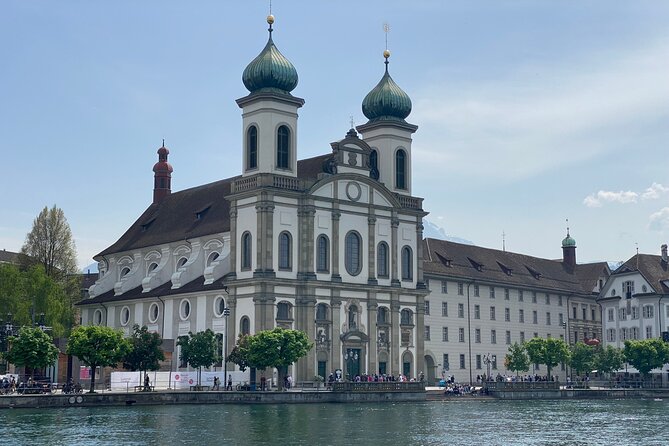
The walk begins at Jesuit Church Lucerne on Bahnhofstrasse. This is a good opening stop because the church gives you an immediate lesson in Lucerne’s Baroque style. You get about five minutes of audio here, enough to take in the graceful exterior and ornate interior without turning the visit into a long church tour.
Admission is free. The church is also a practical starting point in the center of town, so you do not need to arrange special transport before beginning.
Next comes Ritterscher Palace, another five-minute stop. The building itself may look fairly plain compared with Lucerne’s more decorated façades, but its story gives the route some social history. The audio explains how a common worker rose to become the wealthiest person in Lucerne in his time.
That contrast is useful. Instead of looking only at grand churches and civic buildings, you get a glimpse of ambition, money, and changing fortunes. If you prefer architecture alone, this stop may feel brief. If you enjoy stories about the people behind the buildings, it adds welcome variety.
More Self-Guided Tours in Lucerne:
- Mt. Rigi Self-Guided Tour: Lake Lucerne Cruise and Mountain Spa
★ 4.5 · 83 reviews - Lucerne Scavenger Hunt and Sights Self-Guided Tour
★ 4.5 · 14 reviews - The Lives and Legends of Lucerne: A Self-Guided Audio Tour
★ 5.0 · 6 reviews
Quiet churches and the Dance of Death
At Franziskanerkirche, the mood shifts. The Franciscan Church is presented as a quiet place for reflection, with a portal above the entrance showing the coronation of Saint Mary. The stop lasts about five minutes, but you may want to pause longer if the church is open and peaceful.
This part of the route works best when you resist rushing. A self-guided tour lets you lower the audio, look around, and continue when you are ready. A live group would rarely give you that same control.
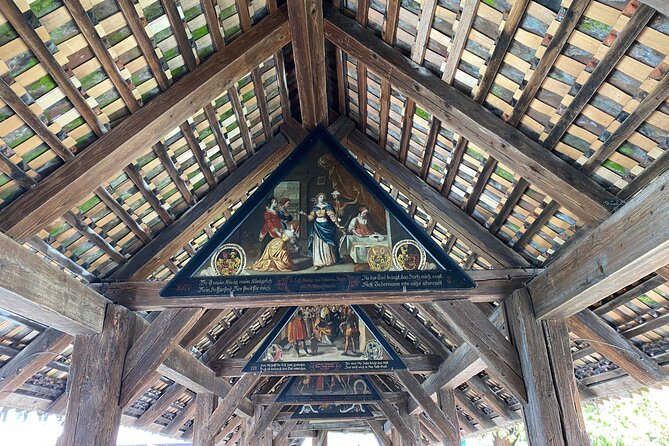
The fourth stop is Spreuer Bridge, one of the more memorable points on the route. Its paintings show a Dance of Death, bringing images of mortality onto a bridge crossing the river. The subject is serious, but it gives the walk a sharper edge than a simple parade of pretty buildings.
You will hear how these paintings served as a reminder that death reaches everyone. The stop is listed as five minutes, though the artwork rewards a closer look. This is one place where the audio adds meaning to what you see above you.
Mühlenplatz and Lucerne’s less-polished stories
Mühlenplatz receives about 20 minutes, making it one of the longer stops. From here, you look toward four locations with difficult or unusual pasts: a former St. James Hospital building that later served as an orphanage, a former prison, a former brothel, and the executioner’s house.
The value here is not visual grandeur. It is the change in subject. Lucerne is often presented through chapels, bridges, and painted façades, but this stop points toward poverty, punishment, illness, and social order. You are asked to observe these places from a picturesque distance while listening to their stories.
The audio’s focus on former institutions may appeal to you if you want more than postcard views. It may feel less satisfying if you expected a faster route through major monuments. Since this is a 20-minute section, your interest in social history matters.
Nölliturm follows with a short five-minute stop. You’ll see the tower’s outline and hear about the Musegg Wall, an important part of Lucerne’s old defensive system. The tower helps connect the city center with its medieval fortifications.
The description gives this stop a visual focus rather than a long architectural lesson. Take a moment to look at the tower’s shape and position before moving on.
Weinmarkt and Hirschenplatz: Lucerne’s painted storybook

Weinmarkt is another 20-minute stop, and this is where the tour’s mural theme becomes impossible to miss. Many buildings around the square carry colorful frescoes, and the audio explains several of them.
You’ll hear about the city’s first pharmacy, a scene showing water becoming wine, and an image announcing Lucerne’s entry into the Swiss union. These are not random decorations. They turn the square into a public record of beliefs, work, civic identity, and political change.
I like this approach because it teaches you how to look at Lucerne. Painted façades are easy to admire and just as easy to walk past without understanding. Here, the audio gives you a reason to stop and connect an image with a story.
Still, this is the tour’s greatest point of tension. If you want architecture, church interiors, and broad city history, 20 minutes on frescoes may feel like too much. The route does not simply mention the paintings in passing. It uses them as one of its main teaching tools.
Hirschenplatz continues the same idea for about 10 minutes. You’ll see more buildings with painted fronts, including images of Goethe, the Battle of Dornach, and a building once owned by a jewelry workshop proprietor. Other façades around the square add further scenes.
The two squares work well together, but they can also feel repetitive. I suggest treating them as a single visual lesson: Weinmarkt introduces the method, while Hirschenplatz gives you more examples. If you are listening with headphones, keep your eyes up and check the buildings before following the next direction.
More things to do in Lucerne:
- Mount Pilatus Summit from Lucerne With Lake Cruise
★ 4.5 · 1,260 reviews - Jungfraujoch Top of Europe Day Trip from Lucerne
★ 4.5 · 840 reviews - Lucerne Walking & Boat Tour: The Best Swiss Experience
★ 4.5 · 417 reviews - Lake Lucerne Panoramic Sightseeing Cruise
★ 4.5 · 363 reviews
Rathaus, Water Tower, and Chapel Bridge
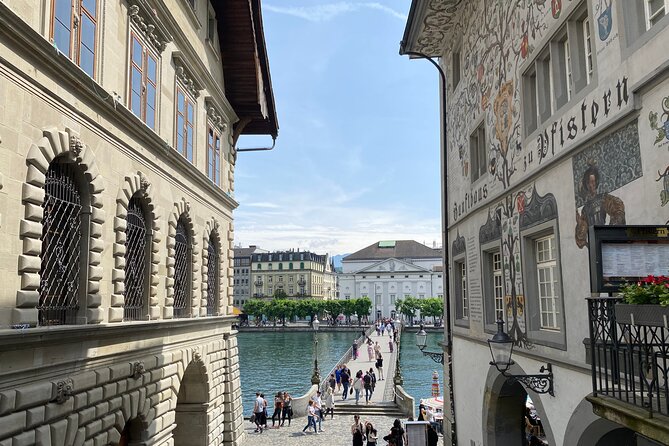
Rathaus Stadt Luzern is a short five-minute stop. The town hall brings civic power into the route, with medieval character and an impressive clock tower. After the long mural sections, this pause provides a change of scale and subject.
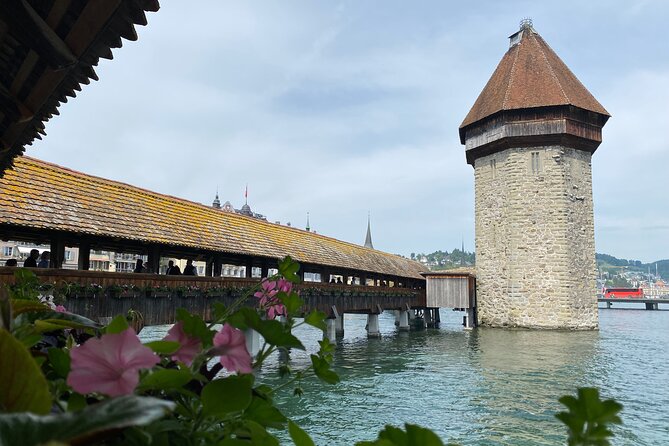
The Water Tower is next. It rises from the river and is one of Lucerne’s most recognizable sights. You’ll hear about its earlier use as a prison, including the grim fact that people once suffered there.
The tower’s location in the Reuss makes it especially easy to appreciate from the banks. You do not need an admission ticket for this stop. The audio adds a darker layer to an object that might otherwise seem like a picturesque river landmark.
Then comes Chapel Bridge, Lucerne’s famous covered crossing. The bridge spans the Reuss and contains paintings that were used for teaching and persuasion. The route treats the artwork as more than decoration, explaining how images could shape public understanding.
Five minutes is enough for a first look, but you may want extra time to cross at your own pace. This is also one of the places where the flexible format helps. You can stop for photographs or pause to study a painting without holding up a group.
St. Peter’s Chapel and Fritschi Fountain
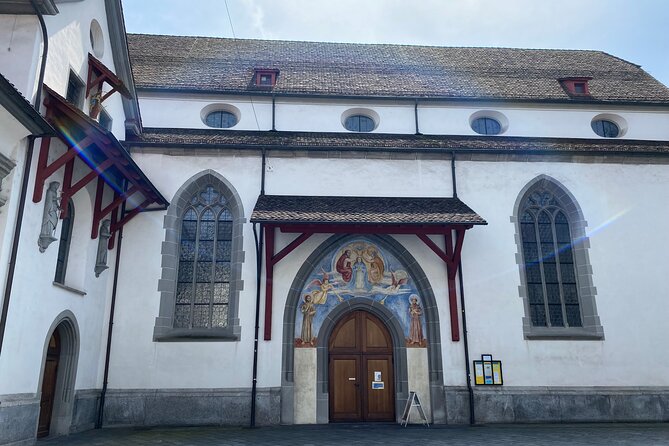
Peterskapelle offers another short look at sacred art. The façade includes Saint Niklaus von Flüe on one side and a fresco connected with the symbolic burden of the world on the other.
The stop is only about five minutes, but it fits the tour’s larger purpose: Lucerne’s meaning is often presented through images on buildings. You are not only checking off a chapel. You are learning to read its exterior.
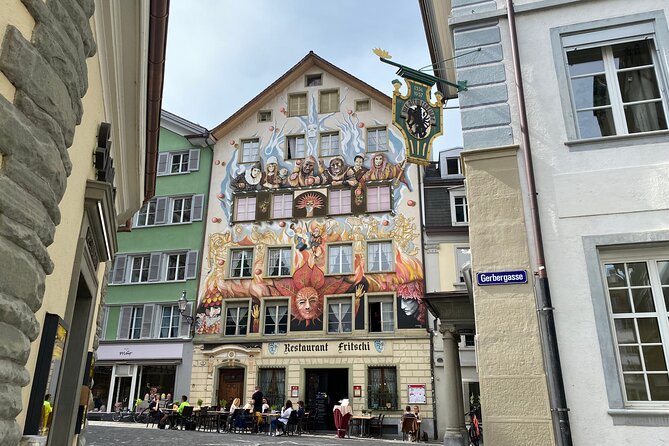
At Fritschibrunnen, the route opens into a more playful visual scene. The fountain is near two colorful buildings. One celebrates carnival, while the other shows seven figures representing virtues.
This 10-minute stop gives the walk some variety after the heavier themes of death, imprisonment, and religious art. It also shows how public decoration can express local celebration and moral ideas side by side.
Hofkirche and the final walk to the Lion Monument
Hofkirche St. Leodegar brings you to one of Lucerne’s most commanding religious buildings. Its symmetrical Gothic towers rise near Lake Lucerne, and the audio points out the image of Saint Michael defeating Satan.
The five-minute timing is enough for a quick orientation, but the church deserves your attention if architecture is a priority. The description emphasizes the towers and the artwork, so listen first, then look closely at the façade and surrounding setting.
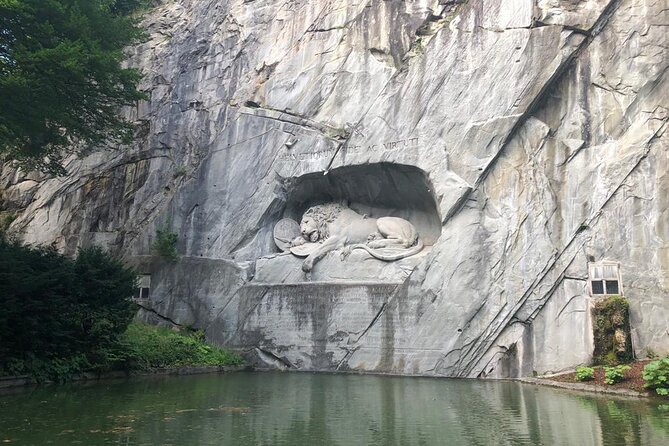
The route finishes at the Lion Monument on Denkmalstrasse. This sandstone sculpture shows a dying lion and honors Swiss Guards killed during the French Revolution. It is a solemn ending, and the change from cheerful façades to a wounded animal gives the walk emotional weight.
The Lion Monument is not treated as just another photo stop. It represents sacrifice and loyalty, and the final position gives the tour a clear ending rather than leaving you in the middle of the Old Town.
How the audio format works in real use
You receive a mobile ticket and a link after booking. The audio is recorded by a professional speaker, and the route includes photos and detailed directions intended to help you find each stop.
The strongest part of the format is control. You can stop for a drink, discuss what you have just seen, or wait until the square is quieter. One person can listen, pause, and restart without a guide needing to repeat information for the whole group.
The weak point is technology. You need your own phone, internet access, and headset. A technical problem can cost you valuable sightseeing time, and there is no live guide to take over if the link fails. Test the link before you reach the starting point, charge your phone, and bring headphones that are comfortable for walking.
The audio style may also divide opinions. It is thorough and slow enough to explain the paintings, but some listeners may find the soundtrack repetitive or the pacing too deliberate. You can help yourself by pausing between stops and treating the audio as a tool, not a command to keep walking.
What $13.29 gets you
At $13.29 per person, this is a low-cost way to put structure around a Lucerne walk. The route covers 15 places, all listed with free admission, and connects major sights with lesser-known stories about former hospitals, prisons, a brothel, and an executioner’s house.
A private live tour would normally give you the advantage of questions and personal recommendations. This audio walk gives you privacy, flexibility, and a much lower price instead. For a couple or small group that already likes exploring independently, the value is strong.
The price is less attractive if you want a broad survey of Lucerne with equal attention to architecture, politics, daily life, and religion. The tour spends a lot of time on frescoes. You are paying for a focused interpretation of the city, not a neutral audio encyclopedia.
Who should choose this Lucerne walk?
I would recommend it to you if you enjoy moving at your own pace and prefer listening rather than joining a group. It suits first-time visitors who want a clear route through the center, especially if you are curious about how painted façades preserve stories.
It is also a good match for couples and families who dislike being hurried. You can pause for food, split up briefly, or replay a section. Most people can participate, service animals are allowed, and the route is near public transportation.
I would hesitate if your main interest is architectural detail or if you lose patience with repeated commentary about murals. The two 20-minute fresco sections are central, not incidental. I would also be cautious if your phone connection is unreliable or you do not want to troubleshoot a digital link.
Practical verdict: book it for freedom, not a live guide
Book this tour if you want a low-cost, private walk with clear directions, English audio, and plenty of time to stop. Its best features are the freedom to explore alone and the unusual stories attached to Lucerne’s painted buildings.
Skip it if you want a fast highlights tour or a guide who can answer questions on the spot. Before booking, decide how you feel about frescoes. If painted façades and the stories behind them sound interesting, the $13.29 price is sensible. If they sound like background decoration, choose another way to see Lucerne.
Free cancellation is available up to 24 hours before the start time for a full refund. Changes or cancellations made within 24 hours are not accepted for a refund, so keep that deadline in mind.
FAQ
How long does the self-guided Lucerne tour take?
The tour is designed to take about one to two hours. The listed stop times add up to approximately two hours if you listen at every location.
Where does the tour begin?
It begins at Jesuitenkirche Luzern, Bahnhofstrasse 11A, 6003 Luzern, Switzerland.
Where does the tour end?
The route ends at the Lion Monument on Denkmalstrasse 4, 6002 Luzern, Switzerland.
Is the audio tour available in English?
Yes. The audio is offered in English.
Do I need my own phone and headphones?
Yes. You need your own mobile phone with internet access and a headset. A link is provided after booking.
Is there a live guide?
No. This is a self-guided audio experience, with no live guide present.
Is the tour private?
Yes. Only your group participates in the activity.
Can I cancel for a full refund?
Yes, if you cancel at least 24 hours before the experience start time. Cancellations within 24 hours are not refunded.
Just added in Lucerne
- Private Transfer: Lucerne to Zurich Airport ZRH by Luxury Van★ 4.5 · 6 reviews
- Touristic highlights of Lucerne on a Private half day tour with a local★ 4.0 · 5 reviews
- Weggis Vitznau Foxtrail Helios★ 4.5 · 8 reviews
- Private Transfer: Lucerne to Zurich Airport ZRH by Business Car★ 5.0 · 11 reviews
- Tandem Flight Zurich-Engelberg★ 5.0 · 7 reviews
- The Lives and Legends of Lucerne: A Self-Guided Audio Tour★ 5.0 · 6 reviews
- Panoramic E-Bike Tour with a Lake Cruise★ 5.0 · 10 reviews
- Paragliding Tandem in Switzerland★ 5.0 · 9 reviews
Self-Guided Tours, compared.
Mt. Rigi Self-Guided Tour: Lake Lucerne Cruise and Mountain Spa
Read our review →
Self-Guided Chamonix with Aiguille du Midi or Mer de Glace
Read our review →
Chamonix Self-guided Sightseeing Tour from Geneva
Read our review →
The Best of Basel’s Hidden Treasures: A Self-Guided Audio Tour
Read our review →
Einstein in Zurich: Walk in Time Exploration Game and Tour
Read our review →
Browse the lists this tour appears in