
Reviewed · HISTORICAL TOURS
Basel Historical Old Town Tour
Basel rewards slow footsteps. This 90-minute walk gives you a useful first look at the city, from the red-painted Town Hall and Basel Minster to the original opera house and its playful Tinguely fountain. I like the focus on Basel’s Old Town and the chance to hear local stories instead of simply ticking off buildings. I also like the tasting of Swiss sweets, a small touch that makes the walk feel more connected to daily life. The main concern is unreliable tour communication, with several serious reports of late cancellations, missing guides, and mixed meeting-point instructions.
The tour costs $21.20 per person, which is a fair price for a small-group introduction if everything runs as planned. Guides such as Jean, Jonas, Lina, Lena, and Ray have received strong praise for clear English, local knowledge, patience, and flexible pacing. Still, you should read the confirmation carefully and verify the meeting point before setting out.
In This Review
- Key points to know before booking
- Why a short walk works well in Basel
- Starting at Kunstmuseum Basel
- Grossbasel and the city’s cross-cultural story
- The 500-year-old Roothus, Basel’s red Town Hall
- Basel Minster and its Romanesque passageways
- The birthplace of pharmaceuticals
- The original opera house and Tinguely fountain
- Swiss sweets and small local pleasures
- What the guide can add
- Price, timing, and overall value
- Who should book this Basel walk?
- Should you book the Basel Historical Old Town Tour?
- FAQ
- How long is the Basel Historical Old Town Tour?
- Where does the tour start?
- Where does the tour finish?
- Is the tour offered in English?
- What sights are included?
- Is a food tasting included?
- How many people can join the tour?
- Can I cancel for a full refund?
Key points to know before booking
- The walk begins at Kunstmuseum Basel, at St. Alban-Graben 16, and returns there.
- Basel Minster provides the tour’s best city views, with Romanesque passageways and a long story tied to Basel’s growth.
- The Town Hall is about 500 years old, with notable artworks inside.
- The original opera house and Tinguely fountain add an artistic finish to the historic walk.
- The group can include up to 15 people, so it is intimate but not necessarily a one-to-one private tour.
- The communication record is mixed, so confirm the time, date, meeting point, and any pickup arrangement directly after booking.
Why a short walk works well in Basel
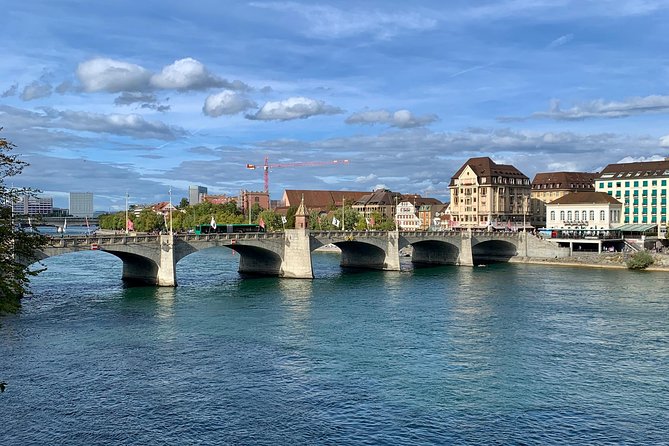
Basel is compact enough to explore on foot, but its story is not always obvious from the street. A grand building may reflect trade, religion, science, art, or the city’s position near several national borders. A guide helps connect those pieces.
This tour is designed as an overview rather than a detailed study of every lane. In an hour and a half, you get the main sights of Grossbasel, hear stories behind the architecture, and receive enough orientation to continue exploring independently.
That format suits you best if Basel is your first stop in Switzerland or if you have only a morning or afternoon available. It also works well at the start of a longer stay. You can use the walk to decide which museums, streets, restaurants, or viewpoints deserve more time later.
The pace appears to be adaptable. Several people praised guides for walking at a comfortable speed and adjusting to older members of the group. That matters in Basel, where cobbled streets and uneven surfaces can make a brisk walk tiring.
More History Tours in Basel:
- Basel Through the Ages: A Journey into History
★ 5.0 · 1 review - Basel – Private Historic Walking Tour
★ 5.0 · 1 review - Zürich Historic District Tour
★ 5.0 · 206 reviews
Starting at Kunstmuseum Basel
The official meeting point is Kunstmuseum Basel, at St. Alban-Graben 16. Starting near an art museum suits Basel, a city with a strong connection to painting, sculpture, design, and modern art.
You should arrive early. The most serious practical problem connected with this experience is confusion over where the guide will be waiting. Some bookings have involved references to Basel SBB railway station, hotel pickup, or another location, while the standard meeting point for this walk is Kunstmuseum Basel.
The safest approach is simple: check the final confirmation as soon as you book, then check it again on the day before the tour. If the message names a different location from the information you received earlier, contact the operator and booking company immediately. Do not assume the discrepancy is a harmless typo.
The guide may not always be easy to identify, so it is reasonable to expect a clear name, sign, or description. This is one area where the operator could do better. You should not have to question random people around a museum or station while the departure time approaches.
Grossbasel and the city’s cross-cultural story
The walk moves into Grossbasel, the older section on the west side of the Rhine. The appeal here is not just a collection of handsome facades. The guide explains how Basel developed as a meeting point of cultures, commerce, religion, science, and art.
That wider setting gives the streets more meaning. You may hear how buildings changed with the city and how old institutions still relate to modern Basel. The strongest guides appear to connect the past with present-day life instead of delivering a string of dates.
Jean, Jonas, Lina, Lena, and Ray have all been singled out for making this kind of storytelling work. Jean was praised for linking earlier events with life in Basel today. Jonas received repeated praise for his relaxed manner, useful answers, and ability to bring the streets to life. Lina was especially appreciated for practical help, including restaurant suggestions and advice on using the city’s transport.
The experience is offered in English. That makes the guide’s communication style important. The best reports describe clear English and an engaging approach, which should help you follow the historical details without feeling trapped in a lecture.
The 500-year-old Roothus, Basel’s red Town Hall
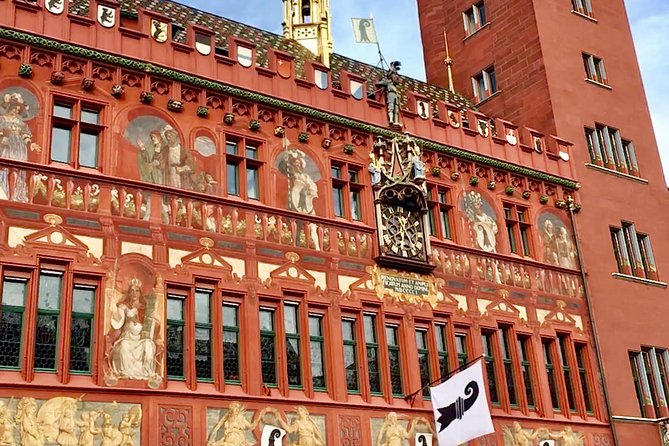
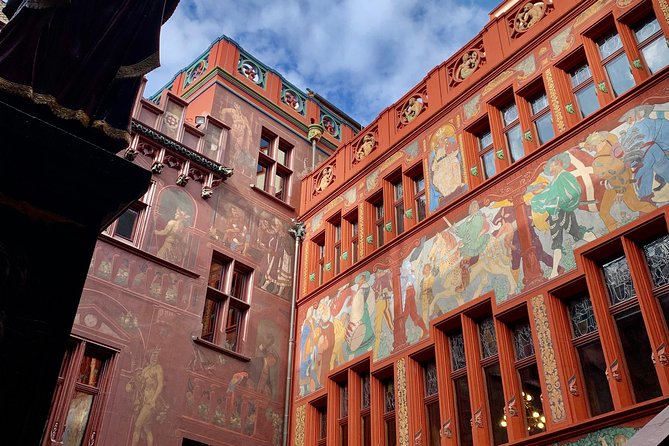
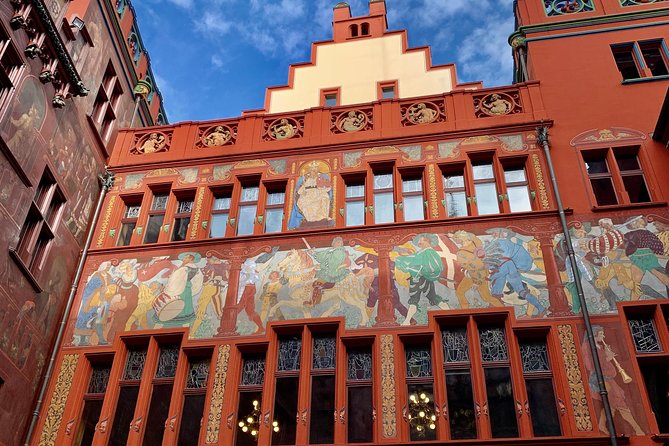
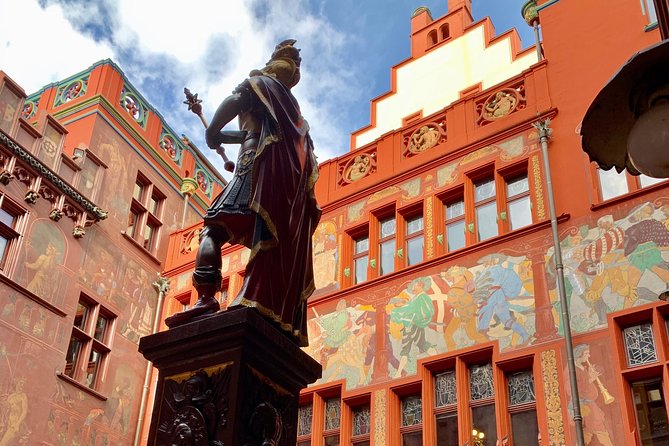
Basel’s Town Hall, known locally as the Roothus, is one of the visual high points of the walk. Its red exterior immediately catches your eye, but the building is more than a photogenic stop.
The Town Hall is about 500 years old and reflects Basel’s civic confidence. Inside, you have the chance to see important European artworks. The guide’s explanation helps you understand why the building matters, rather than treating it as a quick photo stop.
You should keep your expectations measured. This is a walking tour, not a dedicated Town Hall interior visit with extended time for close inspection. The stop is part of a wider route, so the amount of time inside may depend on access and the group’s pace.
Still, this is the kind of place where a guide adds real value. Without context, an ornate civic building can blur into the next one. With a good explanation, the Town Hall becomes a record of Basel’s political and artistic life.
More things to do in Basel:
- Stories of Basel’s Old Town
★ 4.5 · 203 reviews - Basel Farmer’s Market, Cheese, Chocolate & Pastry Tour
★ 4.5 · 171 reviews - Basel City Sightseeing Bus Tour
★ 3.5 · 104 reviews - Mt. Pilatus & Lake Lucerne Cruise Small Group Tour | From Basel
★ 4.5 · 99 reviews
Basel Minster and its Romanesque passageways
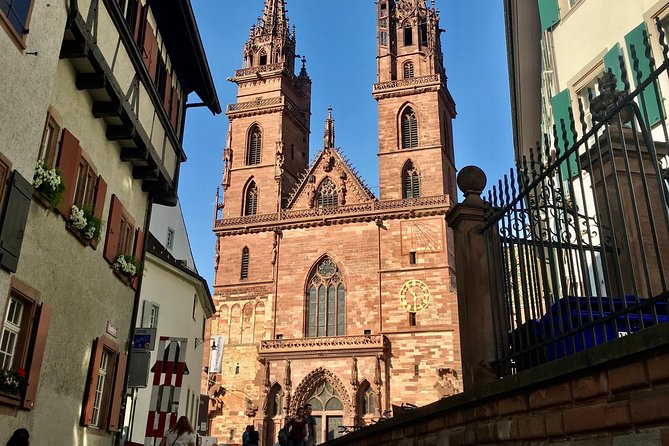
Basel Minster brings together architecture, religion, and views. The cathedral’s Romanesque passageways offer a sense of the building’s age, while the city outlook gives you a broader picture of Basel’s position along the Rhine.
The walk explains how the Minster grew alongside the city into modern times. That idea is useful because it keeps the cathedral from feeling like an isolated monument. Its shape and history are tied to Basel’s changing fortunes.
The 360-degree views are a major reason to value this stop. You can see the city from a different angle than street level, and the viewpoint helps you understand the relationship between the Old Town, the river, and the wider urban area.
There is a practical point here: the route involves walking through historic areas and Romanesque spaces, so comfortable shoes are sensible. The supplied information does not promise elevator access or a fully step-free route. If mobility is a concern, contact the operator in advance and ask about the exact path.
The Minster is also where the guide’s pacing matters most. A rushed group may have little time to take in the architecture or views. The strongest accounts describe a leisurely walk, with guides who adjust to the physical needs of the people in the group.
The birthplace of pharmaceuticals
Basel is closely connected with the pharmaceutical industry, and the tour points out the city’s role in its development. This gives the walk a useful modern angle.
You are not only looking at medieval streets. Basel’s identity also comes from science, business, and international industry. The contrast between old stone buildings and a modern pharmaceutical center is part of what makes the city interesting.
The itinerary does not provide a separate laboratory visit or museum admission, so treat this as a story and location-based explanation rather than a technical pharmaceutical tour. The value comes from seeing how the city’s past and present sit close together.
For me, this is one of the better reasons to choose a guided walk rather than exploring alone. A self-guided route can show you the facades, but it may not explain why Basel became important in this field.
The original opera house and Tinguely fountain
The route finishes with a change of mood at Basel’s original opera house. After the civic buildings, cathedral spaces, and old lanes, this stop points toward the city’s performing arts and modern design.
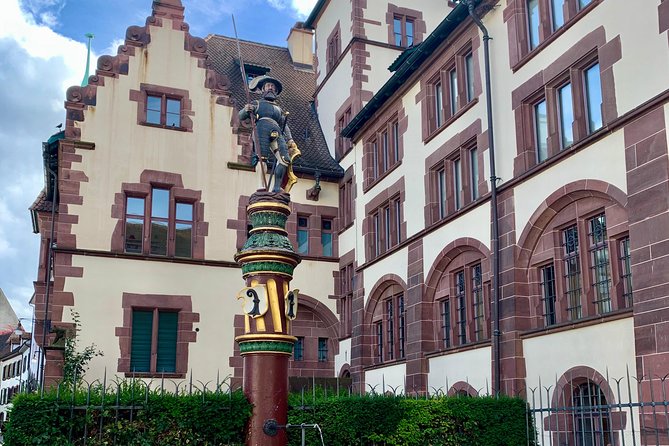
Outside, the Tinguely fountain adds movement and humor. Its whimsical mechanical forms are a sharp contrast to the serious stone architecture earlier in the walk. This is a memorable ending because it shows that Basel is not preserved in the past.
The opera house itself is included as a landmark on the route, but the experience is not described as a full performance, backstage visit, or interior tour. You should expect an exterior-focused stop and an explanation from the guide.
This part of the walk may appeal strongly to anyone interested in art. Basel’s cultural reputation does not rest only on museums. It also appears in public sculpture, architecture, and the way the city uses public spaces.
Swiss sweets and small local pleasures
The Swiss sweets tasting is a modest but welcome feature. It gives you a chance to try something associated with the country instead of spending the entire 90 minutes looking at buildings.
Do not expect a full food tour. The tasting is one element within a history walk, not the main event. The supplied details do not specify the sweets, the quantity, or the tasting location, so you should see it as a small bonus rather than a reason to book on its own.
I like this touch because food can make a place easier to remember. A bite of something sweet, followed by a story about Basel’s neighborhoods or traditions, gives the tour a more human rhythm.
What the guide can add
The guide makes or breaks this experience. The best reported qualities are clear explanations, a relaxed style, useful answers, and a willingness to adapt.
Jean has been praised for making Basel’s past feel connected to life today. Jonas appears repeatedly as a strong choice for history, restaurant advice, and a comfortable walking pace. Lina has been praised for going beyond the basic route, answering questions, and helping with practical plans after the walk. Lena has been appreciated for her history explanations and care with older participants. Ray has been described as highly capable and accommodating.
These individual accounts suggest that the operator has several excellent guides. They also show why you should not judge the tour only by its route. The buildings are worthwhile, but the stories and personal attention determine how much you take away.
The group limit is 15 people. That is small enough for questions to be realistic, but it does not guarantee a private tour in the usual sense. If you want a completely exclusive experience, confirm the group arrangement before paying.
Price, timing, and overall value
At $21.20 per person, the tour is priced as an affordable introduction to Basel. For 90 minutes with a local guide, landmark commentary, and a Swiss sweets tasting, I consider that good value if you want orientation rather than an exhaustive history lesson.
The price is especially sensible for a first morning in the city. A good guide can help you understand where you are, point out places worth returning to, and offer practical restaurant or transport suggestions. Lina’s help with restaurant research shows the possible value of that personal advice.
The tour is often booked about 36 days in advance. That does not prove every departure sells out, but it suggests you should not wait until the last minute if your schedule is fixed.
The duration is also easy to fit around train travel, museum time, or an evening meal. The walk ends back at the starting point, which simplifies planning. You do not need to arrange a separate transfer from the final stop.
The important qualification is operational reliability. Several bookings have been affected by a guide not appearing, a cancellation close to departure, a changed time, or poor communication. One group was moved from 2 p.m. to 5 p.m., when the weather had become colder and the light was fading. Another received a message shortly before departure that appeared to move the tour to the next day.
Those problems are not minor. A cheap tour is not good value if it costs you a morning in Basel and leaves you waiting at the wrong place. Build in a confirmation check, keep the operator’s contact details handy, and avoid scheduling an important train immediately afterward.
Who should book this Basel walk?
I would choose this tour if you want a short, English-language introduction to the Old Town and prefer stories to a printed map. It is a good match for first-time visitors, couples, families with older children, and people who want a guide to set the city in context.
It also suits older people who appreciate a measured pace. Several guides have shown care with physical comfort, though you should still ask about the route if stairs or uneven paving could be difficult.
Art lovers will appreciate the links between Kunstmuseum Basel, the Town Hall artworks, the opera house, and the Tinguely fountain. History fans will enjoy the Minster, Grossbasel lanes, and the way the tour connects old Basel with the pharmaceutical industry.
I would be more cautious if your schedule is very tight or if you need a confirmed hotel pickup. Hotel collection appears to require advance confirmation, and some booking details have not reached the operator correctly. The standard meeting point is Kunstmuseum Basel, not automatically your hotel or Basel SBB.
The free cancellation rule is useful: you can cancel up to 24 hours before the start time for a full refund. Changes or cancellations made less than 24 hours before departure are not accepted for a refund, and the tour requires a minimum number of participants. If the operator cancels because that minimum is not met, you should be offered another date or experience, or a full refund.
Should you book the Basel Historical Old Town Tour?
Yes, with a careful confirmation check.
The route covers a lot in 90 minutes: Grossbasel, the Roothus, Basel Minster, Romanesque passageways, the pharmaceutical story, the opera house, the Tinguely fountain, and a Swiss sweets tasting. The price is modest, and guides such as Jonas, Jean, Lina, Lena, and Ray have delivered the warm, informative experience you want from a city walk.
But I would not book it blindly. The repeated problems with missing guides, changed times, unclear pickup arrangements, and conflicting meeting locations are serious enough to affect your decision. Confirm the exact date, departure time, meeting point, guide contact, and any hotel pickup in writing.
If those details are settled, this is a practical way to get your bearings fast and see why Basel is more than a pretty Swiss Old Town. If the operator cannot clearly confirm the arrangements, choose a plan with less risk, especially on a short stay.
FAQ
How long is the Basel Historical Old Town Tour?
The tour lasts approximately 1 hour and 30 minutes.
Where does the tour start?
The stated meeting point is Kunstmuseum Basel, St. Alban-Graben 16, 4051 Basel, Switzerland.
Where does the tour finish?
The activity ends back at the meeting point.
Is the tour offered in English?
Yes. English is the stated tour language.
What sights are included?
The route includes Basel’s Old Town in Grossbasel, the 500-year-old Roothus or Town Hall, Basel Minster, Romanesque passageways, the original opera house, and the Tinguely fountain. It also covers Basel’s connection with pharmaceuticals.
Is a food tasting included?
Yes. The experience includes a tasting of Swiss sweets.
How many people can join the tour?
The maximum group size is 15 people.
Can I cancel for a full refund?
Yes, if you cancel at least 24 hours before the experience start time. Cancellations or changes made less than 24 hours before the start are not accepted for a refund.
Just added in Basel
- The nightwatchman’s secret★ 5.0 · 3 reviews
- Private day trip Basel to Zurich and Lucerne with a local driver★ 4.5 · 2 reviews
- Sail to Basel and then explore either Bern, Luzern, Zurich or the Swiss Alps.★ 5.0 · 1 review
- Tour on the vintage tram★ 4.0 · 8 reviews
- Private Transfer from Basel City to Zurich City★ 5.0 · 1 review
- Glacier Express Panoramic Train Round Trip in one Day Private Tour from Basel★ 4.0 · 13 reviews
- Private Day Trip From Basel to Zurich, English Speaking Driver★ 5.0 · 2 reviews
- Jungfraujoch Top of Europe Private Day Trip from Basel★ 5.0 · 8 reviews
Historical Tours, compared.
Highlights of Geneva: Dark History Quest Experience
Read our review →

Private Mystic Zermatt Tour: Peaks, History & Culture
Read our review →
Historic Lausanne: Exclusive Private Tour with a Local Expert
Read our review →
Historic St. Gallen: Exclusive Private Tour with a Local Expert
Read our review →

Browse the lists this tour appears in