
Reviewed · WALKING TOURS
Private Classic Lucerne City Walk
Lucerne reveals its best stories on foot. This private two-hour walk links the Lion Monument, medieval Old Town, Musegg Wall, Ritter Palace, Jesuit Church, and Chapel Bridge with a local guide who can adjust the pace to suit your group. I especially like the hotel pickup and the chance to climb the Musegg towers, two useful touches that save time and add real character. The main drawback is that several sights have limited access on certain days or in winter, and $198 per person is a serious price for a two-hour tour.
The tour is led by a local English-speaking guide, with Ralf praised repeatedly for clear explanations, good timing, and helpful restaurant, chocolate, shopping, and museum suggestions. I also like the private format, since your group can ask questions, move at a comfortable pace, and adjust the route around other plans. Still, this is not a slow museum morning. You cover a lot of ground, including a hill and tower stairs, so sensible shoes matter.
In This Review
- Key points to know before booking
- Why this private Lucerne walk works well
- Starting at your hotel, then heading to the Lion Monument
- Climbing the Musegg Wall and Clock Tower
- Hirschenplatz, Kornmarkt, and the city’s old fountains
- Crossing the Reuss and entering Ritter Palace
- Jesuit Church and the meaning of Chapel Bridge
- Finishing at Peter’s Chapel and Rosengart Platz
- What the $198 price gets you
- Walking effort, weather, and timing
- Who should book the Classic Lucerne City Walk?
- Should you book it?
- FAQ
- How long does the Private Classic Lucerne City Walk last?
- Where does the tour begin?
- Is transportation included?
- Can I visit the Musegg Wall towers in winter?
- Is Ritter Palace open every day?
- Can I cancel the tour for a full refund?
Key points to know before booking
- Hotel pickup keeps the start simple: Meet your guide in your Lucerne hotel lobby, or arrange pickup at the large arch beside the main train station.
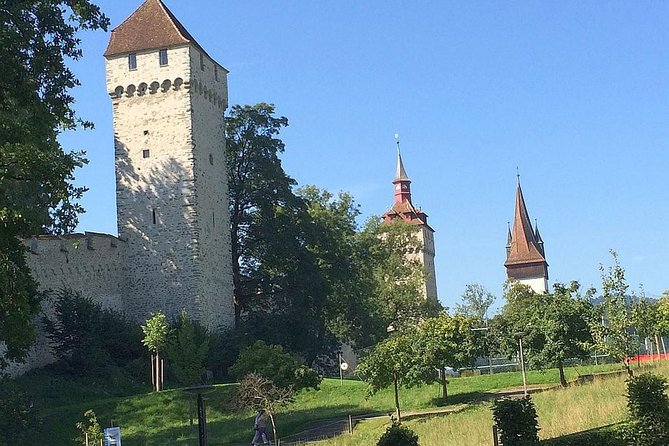
- The Musegg Wall supplies the best outlook: A short uphill walk leads to the old fortifications, Schirmer Tower, the defense walk, and the Clock Tower.
- The tour packs in Lucerne’s essential sights: You visit the Lion Monument, Hirschenplatz, Kornmarkt, Wine Market, Reuss Bridge, Jesuit Church, Chapel Bridge, and Peter’s Chapel.
- Ritter Palace access depends on the calendar: The interior and Danse Macabre paintings are unavailable on Saturdays, Sundays, holidays, and special-event dates.
- Winter changes the route: From November through March, the Musegg Wall and towers can be viewed only from outside.
- The guide adds practical help: Ralf has offered dining, shopping, museum, and chocolate advice that can make the rest of your Lucerne stay easier.
Why this private Lucerne walk works well
Lucerne can feel easy to understand at first glance. There is the lake, the river, the famous wooden bridge, and a compact Old Town. Yet the city’s most interesting details sit in the connections between those sights: the military story behind the Lion Monument, the role of the Reuss in city life, the old walls above the center, and the religious buildings that shaped Lucerne after the Reformation.
That is where a private guide earns the fee. You are not just pointed toward Chapel Bridge and sent on your way. The walk explains why the bridge has its name, why the Water Tower once held prisoners, how the old fountains supplied Lucerne, and what the painted façades around Hirschenplatz are telling you.
The two-hour length is useful for a first morning or afternoon. You get a strong outline of the city without giving up an entire day. The tradeoff is pace. The stop times are short, often five or ten minutes, so this is a guided overview rather than an extended visit inside each sight.
More Walking Tours in Lucerne
- Lucerne Walking & Boat Tour: The Best Swiss Experience
★ 4.5 · 417 reviews - Exclusive Private Lucerne Walking Tour with Local Guide 3 Hours
★ 5.0 · 80 reviews - 1.5-Hour Small-Group Nightwatchman Walk in Medieval Lucerne
★ 4.5 · 34 reviews
Starting at your hotel, then heading to the Lion Monument
Your guide meets you in the lobby of a Lucerne hotel within the city limits. After a quick introduction, the route is explained on a city map. Depending on your hotel, you either walk or use the public bus to Lion Square.
Lucerne overnight guests receive a Visitor Card from their hotel, which provides free public transportation during their stay. Bring that card with you. If you are staying outside the covered hotel area, any public transportation cost is not included, so it is worth checking the pickup details before the morning begins.
The first stop is the Bourbaki Panorama, seen from outside. You receive a brief explanation of the museum and the story connected with it, but the tour does not include an interior museum visit. This is a short orientation stop, not a full museum experience.
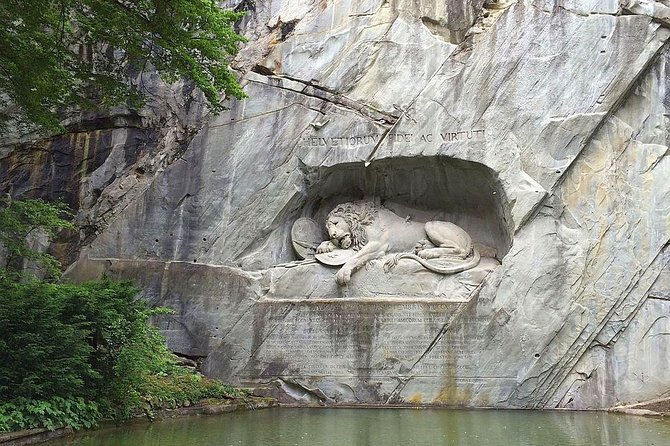
A few steps later, the Lion Monument provides one of the tour’s strongest history lessons. The wounded lion commemorates the Swiss Guards killed during the French Revolution. Your guide explains how Swiss soldiers served rulers across Europe, much as the Swiss Guard still serves the pope, and how the attack on the French king’s palace in Paris led to the deaths of about 800 Swiss guards.
The stop takes only about five minutes, but the subject is serious and memorable. I like this early pairing of the Bourbaki story and the Lion Monument because it gives you a sense of Lucerne beyond postcard scenery. The city’s polished streets and beautiful views sit alongside stories of war, service, and political change.
Climbing the Musegg Wall and Clock Tower
From Lion Square, you walk uphill for about ten minutes to the Musegg hill. This is the most physically demanding part of the route, though the walk is described as leisurely. The reward is a look at one of Lucerne’s remaining medieval fortifications.
The Musegg Wall dates from the early fifteenth century. You visit two towers, climb Schirmer Tower, walk along the old defense path, and climb to the top of the Clock Tower. From up there, you can look across the city, the Alps, and the surrounding midland.
This is the tour’s best break from street-level sightseeing. On the Old Town lanes, you see attractive buildings and hear useful stories. On the wall, you get a sense of how the city was protected and how its position beside the river and lake shaped its growth.
The towers are open only during the warmer part of the year. From November through March, you can see the wall and towers from outside, but you cannot climb them. That seasonal limit matters because the Musegg section supplies much of the tour’s physical and visual appeal.
A particularly thoughtful detail is the guide’s handling of time. One group had the climb arranged so the Clock Tower bell rang during the ascent. That kind of timing is exactly what a private guide can sometimes arrange, though it should not be treated as a guaranteed feature.
Hirschenplatz, Kornmarkt, and the city’s old fountains
After the wall, the route returns to the heart of the Old Town. At Hirschenplatz, or Stag Square, you see medieval houses with painted façades. Look up as you walk. The decoration is easy to miss if you are focused only on shop windows and street signs.
At Kornmarkt, the Town Hall and its tower tell another part of Lucerne’s story. The building dates from the early seventeenth century, and your guide points out its unusual clock, which has no minute hand. It is a small detail, but exactly the sort of detail that gives a short city walk personality.
You then continue to the Wine Market, once known as the Fish Market. Here you learn about the old city fountains and the spring water associated with them. The tour includes a taste of the water from Lucerne’s oldest fountain.
That brief taste is a nice local touch. It costs nothing, takes little time, and connects the grand buildings with ordinary city life. You are not simply looking at façades. You are hearing how people used the squares and fountains in earlier centuries.
A completely different kind of day:
- Mount Pilatus Summit from Lucerne With Lake Cruise
★ 4.5 · 1,260 reviews - Jungfraujoch Top of Europe Day Trip from Lucerne
★ 4.5 · 840 reviews - Lake Lucerne Panoramic Sightseeing Cruise
★ 4.5 · 363 reviews - Mt Titlis Cable Car from Engelberg with Ice Flyer
★ 4.5 · 290 reviews
Crossing the Reuss and entering Ritter Palace
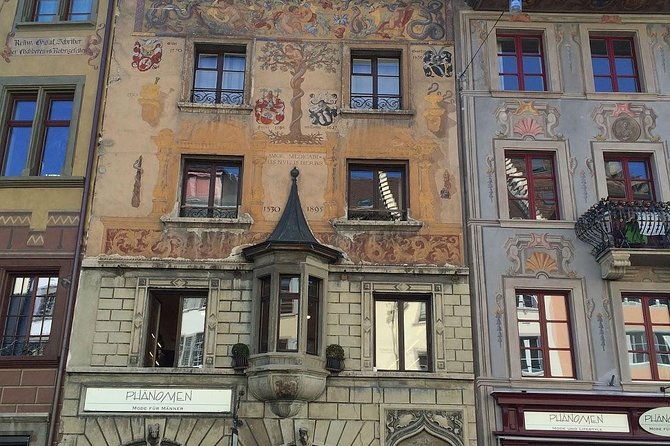
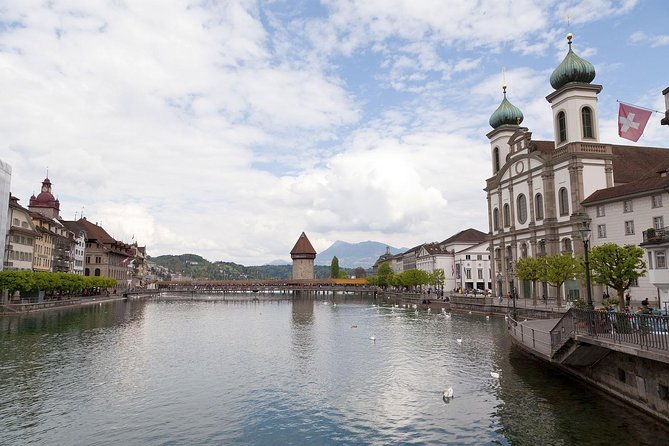
At the lower Wine Market, you pass the former site of a pillory before crossing the Reuss on the Reuss Bridge. From the bridge, you can see the river, the needle dam, the Spreuer Bridge, and two Musegg towers.
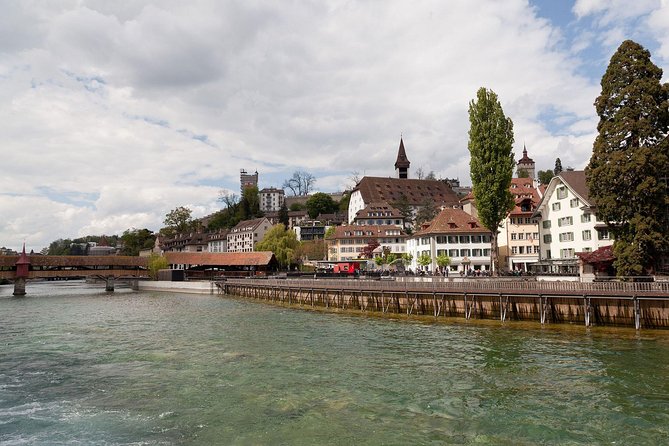
This is a compact but useful viewpoint. Lucerne’s waterways are central to its appearance, and the view helps you place the Old Town within the wider city. The needle dam controls the lake’s outflow into the Reuss, while the nearby wooden bridge adds another layer to the city’s collection of historic crossings.
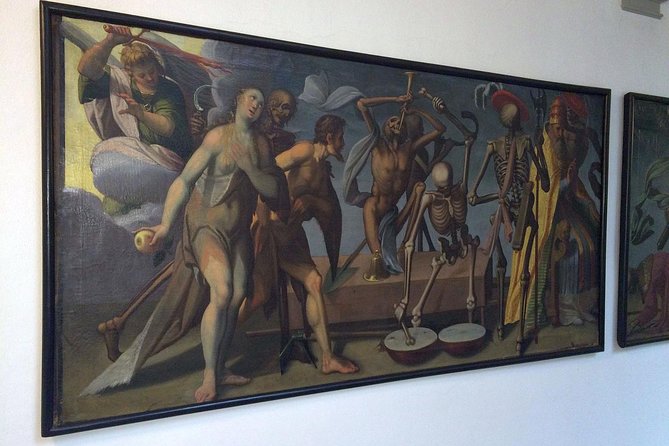
A few steps farther, you reach the Ritterscher Palast, also called Ritter Palace. Inside, you learn about this sixteenth-century Florentine-style palace and see the Danse Macabre gallery, a series of seven paintings by Jakob von Wyl.
For many people, this will be the tour’s most distinctive interior visit. The Dance of Death paintings give the guide a chance to discuss mortality, social rank, and the way art once delivered moral lessons. One guide was singled out for explaining these panels particularly well, so this section can be more than a quick look at old artwork.
Plan around the closure schedule. Ritter Palace is closed on Saturdays, Sundays, public holidays, and during special events. On those dates, you see the building from outside only. Since the palace is one of the few planned interior stops, check the day before you book.
Jesuit Church and the meaning of Chapel Bridge
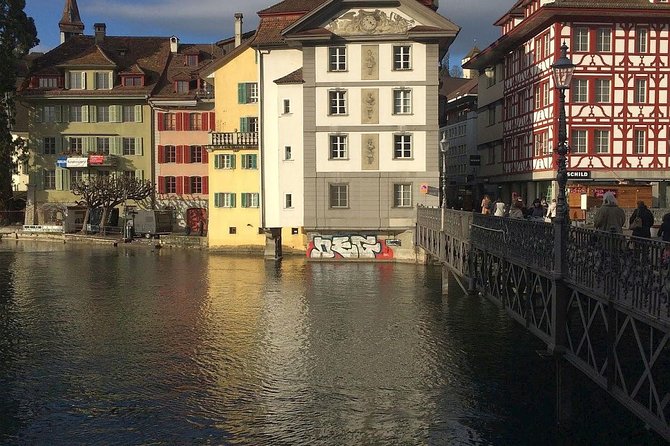
The route continues to the Jesuit Church, built in the seventeenth century as the first Baroque church in Switzerland. Your guide explains the church before you have the chance to enter.
Interior access can be restricted during Mass. As with Ritter Palace, the short timing means you should think of this as an introduction rather than a full church visit. Still, the church adds an important religious and artistic chapter to the walk, especially after the military stories at the Lion Monument and Musegg Wall.
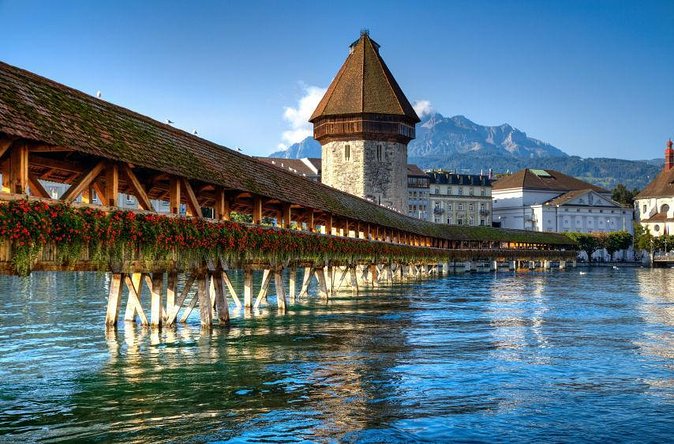
A few steps upriver brings you to Chapel Bridge, Lucerne’s most famous sight. The wooden bridge once formed part of the city’s defenses, and its Water Tower had several uses, including serving as a prison.
The bridge’s interior paintings are a major part of the experience. Your guide gives you context for the paintings and the bridge’s former role, helping you look beyond the familiar photographs. The Water Tower also becomes more interesting once you know it was not simply a decorative stone tower.
The bridge is one of Lucerne’s busiest photo stops, but the guided explanation keeps it from becoming a quick picture and move-on moment. You learn why it is called Chapel Bridge and how the nearby chapel connects to the name.
Finishing at Peter’s Chapel and Rosengart Platz
The walk ends at Rosengart Platz beside St. Peter’s Chapel, the first church in Lucerne, dating from the twelfth century. Nearby, you see the Zur Gilgen House, described as the first private stone house in the city, dating from the early sixteenth century.
This is a fitting end because it brings together Lucerne’s religious, domestic, and civic past. You finish with more than the city’s most famous bridge. You have also seen where people worshiped, lived, defended the city, traded, and crossed the river.
Your guide remains available for further Lucerne questions and can take you back to your hotel by public transportation or on foot. That follow-up is valuable if this is your first day in town. You can ask about dinner, museums, shopping, or other activities while the city is still fresh in your mind.
The practical suggestions have been a strong part of the experience. Ralf, in particular, has been praised for restaurant and riverside lunch recommendations, along with advice about chocolate and museums. I would save a few questions for the end rather than treating the walk as a closed script.
What the $198 price gets you
At $198 per person, this is not a budget walk. The price makes the most sense for a small private group that values personal attention and hotel pickup. You are paying for a professional local guide, a route that connects many major sights, private pacing, taxes and handling charges, and three exclusive postcards featuring Old Lucerne.
The value improves if you have only a short stay. In two hours, you cover the main Old Town sights, gain access to the Musegg Wall and towers when they are open, and receive practical advice for the rest of your visit. You also avoid losing time finding a meeting point.
For a larger family or friend group, ask about group discounts. The private setup is especially useful when ages and walking speeds differ. A guide can keep the route moving while answering individual questions, rather than forcing everyone into a fixed public-tour rhythm.
The price is harder to justify if you want long museum visits, extended photography stops, or a leisurely café break. Several stops last only five minutes, and the tour is designed to connect the sights. You should book it for orientation and context, not for deep time inside each attraction.
Walking effort, weather, and timing
The tour runs in all weather, so dress for the forecast. The route includes ordinary city walking, a ten-minute uphill section to the Musegg Wall, and stairs in the towers. Comfortable shoes are more important than stylish ones.
Most people can take part, and the route suits families particularly well. One family group found the walk manageable for older relatives and young children, helped by the hotel pickup and steady pace. Still, anyone who has trouble with hills or tower stairs should ask the guide about the route before starting.
The schedule can be adjusted. Groups have had the order changed to fit other plans, and one guide timed the Clock Tower climb around the hourly bell. That flexibility is one of the clearest benefits of booking privately.
The tour is offered in English and confirmation arrives when you book. Service animals are allowed, and the route stays near public transportation. Free bus travel may apply if you are staying in a Lucerne hotel and have the Visitor Card.
Who should book the Classic Lucerne City Walk?
I would choose this tour at the start of a Lucerne stay, especially if you have one or two days and want a clear sense of place before exploring alone. It suits first-time visitors, families, couples who want a private guide, and anyone who prefers stories and context over a simple list of sights.
It is also a good fit for travelers who like to ask questions. The strongest praise has centered on guides who explain clearly, keep the walk moving, and offer useful recommendations beyond the official route. Ralf has been especially well regarded for combining facts with practical local advice.
I would think twice if you are visiting from November through March and expect to climb the Musegg Wall. You will still see it from outside, but one of the tour’s best sections changes. I would also avoid a weekend or holiday booking if the inside visit to Ritter Palace is important to you.
Finally, consider your budget. $198 per person is a premium rate for two hours, but the private pickup, adaptable schedule, and concentrated coverage can be worthwhile for a small group with limited time.
Should you book it?
Book the Private Classic Lucerne City Walk if you want a polished introduction to Lucerne, personal guidance, and a route that combines famous sights with less obvious details. The Musegg Wall climb, Clock Tower view, Danse Macabre gallery, fountain tasting, and hotel pickup give it more substance than a basic Old Town stroll.
Skip it if you prefer to wander independently, spend long periods inside museums, or keep costs low. Before choosing a date, confirm two details: Musegg Wall access from April through October, and Ritter Palace access outside weekends, holidays, and special events. With those limits understood, this is a strong first-day tour for seeing Lucerne quickly and intelligently.
FAQ
How long does the Private Classic Lucerne City Walk last?
The tour lasts approximately two hours, though the exact timing can be adjusted to fit your group’s plans.
Where does the tour begin?
Your guide can pick you up at any hotel within Lucerne’s city limits. You can also arrange pickup at the large arch beside Lucerne main station.
Is transportation included?
Walking is used for much of the route. Public transportation may be used between your hotel and the Lion Square or on the return journey. Transportation tickets are not included, but Lucerne hotel guests are entitled to free public transportation during their stay with the hotel-issued Visitor Card.
Can I visit the Musegg Wall towers in winter?
From November through March, the Musegg Wall and towers are closed for interior visits. You can see them from the outside only.
Is Ritter Palace open every day?
No. Ritter Palace is closed on Saturdays, Sundays, public holidays, and during special events. On those dates, you can visit the exterior only.
Can I cancel the tour for a full refund?
Yes. You can cancel at least 24 hours before the experience start time for a full refund. Cancellations or changes made less than 24 hours before the start time are not accepted for a refund.
Just added in Lucerne
- Private Transfer: Lucerne to Zurich Airport ZRH by Luxury Van★ 4.5 · 6 reviews
- Touristic highlights of Lucerne on a Private half day tour with a local★ 4.0 · 5 reviews
- Weggis Vitznau Foxtrail Helios★ 4.5 · 8 reviews
- Private Transfer: Lucerne to Zurich Airport ZRH by Business Car★ 5.0 · 11 reviews
- Tandem Flight Zurich-Engelberg★ 5.0 · 7 reviews
- The Lives and Legends of Lucerne: A Self-Guided Audio Tour★ 5.0 · 6 reviews
- Panoramic E-Bike Tour with a Lake Cruise★ 5.0 · 10 reviews
- Paragliding Tandem in Switzerland★ 5.0 · 9 reviews
Walking Tours, compared.
Zurich Walking Tour With Cruise and Aerial Cable Car
Read our review →
Lucerne Walking & Boat Tour: The Best Swiss Experience
Read our review →
3 in 1: Zurich Walking Tour – Cruise on the Lake – Cable Car Ride to Felsenegg
Read our review →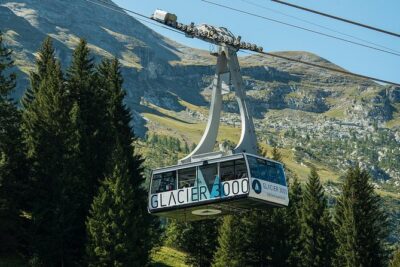
Glacier 3000 Ticket Including Cable Car and Peak Walk by Tissot
Read our review →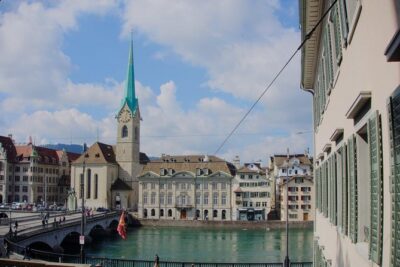
Zurich Private Customizable Guided Walking Tour
Read our review →
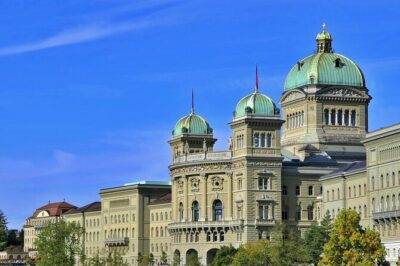
Bern Walking Tour: Explore Top Sights & Hidden Gems
Read our review →Browse the lists this tour appears in