
Reviewed · SELF-GUIDED TOURS
Self-Guided Reading City Tour in Zurich
Zurich rewards a slow, curious walk. This self-guided reading tour connects major sights with stories about reformers, politicians, artists, revolutionaries, and accused criminals. I like the wide historical range, and I like that you can pause whenever a church, view, or sculpture deserves more time. The main drawback is simple: you need your own phone and internet, and the reading can take longer than the advertised two to three hours.
At $6.23 per person, this is an easy way to get a city introduction without joining a group. You follow a link, read the material, and walk from Bahnhofplatz through the old center and along the Limmat. The visit inside Fraumünster costs an extra CHF 5, so budget for that if Chagall’s windows are on your must-see list.
In This Review
- Key points to know before you start
- What this Zurich reading tour is really like
- Alfred Escher and Pestalozzi: Zurich begins with people
- Lindenhof Hill gives you the best pause
- St. Peter’s and Thermengasse reveal older Zurich
- Rathaus, Cabaret Voltaire, and Lenin’s apartment
- Grossmünster: Reformation and colored light
- Wasserkirche and Zwingli’s monument
- Opera House, Ganymed, and Hans Waldmann
- Fraumünster, Paradeplatz, and Augustinerkirche
- Bahnhofstrasse, Weinplatz, and Max Bill
- How the $6.23 price holds up
- Who will get the most from this experience?
- Should you book the Zurich self-guided reading tour?
- FAQ
- How much does the self-guided Zurich tour cost?
- How long does the tour take?
- Is there a live guide?
- What do I need to use the tour?
- Where does the tour start?
- Where does the tour end?
- Is Fraumünster Church admission included?
- Is Grossmünster admission included?
- Is this a group tour?
- Can I cancel for a full refund?
Key points to know before you start
- A history-heavy route: You move from Alfred Escher and Pestalozzi to Zwingli, Lenin, Dada artists, and Hans Waldmann.
- Two to three hours, or longer: Short stops are listed at most locations, but reading every passage can take almost three hours by itself.
- A strong old-town walk: Lindenhof, St. Peter’s, the Roman baths, Rathaus, Grossmünster, Wasserkirche, and Fraumünster form the heart of the route.
- No live guide: You receive directions, photographs, and written explanations through a mobile link after booking.
- Low cost with one notable extra: The tour costs $6.23, while entry to Fraumünster is CHF 5 if you go inside.
- Private and flexible: Only your group takes part, and you can set your own pace.
What this Zurich reading tour is really like
This is not a guided walk with a person waiting at the station. It is a digital route through central Zurich, built for people who prefer reading, stopping, and looking around without keeping up with a group.
The starting point is Bahnhofplatz, a practical place near Zurich’s main railway station. From there, the route works through the city center in a generally sensible progression, mixing major sights with smaller monuments and details you could easily pass without noticing.
You get more than dates and building names. The material deals with people who shaped Zurich through education, railways, religion, finance, politics, art, and revolution. Some stories involve brave choices. Others involve power struggles, executions, failed hopes, and hard moral questions. That gives the walk more character than a simple checklist of churches.
The advertised duration is two to three hours. That estimate makes sense if you read selectively and keep moving. If you read every section carefully, allow extra time. One piece of feedback describes nearly three hours of reading in Russian alone, which tells you this is not a skimpy audio-guide substitute. It is a substantial reading experience.
More Self-Guided Tours in Zurich
- Zurich City Tour with Audio Commentary
★ 4.0 · 372 reviews - Einstein in Zurich: Walk in Time Exploration Game and Tour
★ 4.0 · 25 reviews - Self-Guided Audio City Tour in Zurich
★ 4.0 · 15 reviews
Alfred Escher and Pestalozzi: Zurich begins with people
The first stop is the Alfred Escher Statue, near the opening part of the walk. Escher was a major Swiss politician whose work helped shape the country’s economy and railway system. The statue is a useful first lesson in how Zurich grew from a medieval city into a modern financial and transport center.
Next comes Pestalozzianlage and the monument to Johann Heinrich Pestalozzi. Pestalozzi is linked with major changes in education and ideas about how children should learn. This stop shifts the focus from railways and economic growth to social reform.
Each stop is listed at about five minutes, but the reading may take longer. That is one of the tour’s strengths and one of its small frustrations. The route gives you plenty of context, but you should not expect to rush through it and absorb every detail.
You also pass Zurich’s Urania Observatory, where the focus turns briefly from city streets to the night sky. The observatory is not given a numbered stop in the supplied route, so pay attention to the directions and photographs in the mobile guide.
Lindenhof Hill gives you the best pause
Lindenhof is one of the most rewarding places on the walk. This hilltop viewpoint looks across Zurich and the Limmat River, giving you a chance to stop reading and simply get your bearings.
The route adds several details here: the Hedwig Fountain, the Masonic Lodge, and the Tombstone of Lucius Aelius. These smaller features make Lindenhof more than a viewpoint. You get a mix of local story, architecture, and a slightly somber reminder of the people connected with the city long ago.
Plan about ten minutes at Lindenhof, though this is a place where I would ignore the clock. The view helps you understand how compact central Zurich is. It also makes the next section of the walk easier to follow because you have seen the river and the old center from above.
St. Peter’s and Thermengasse reveal older Zurich
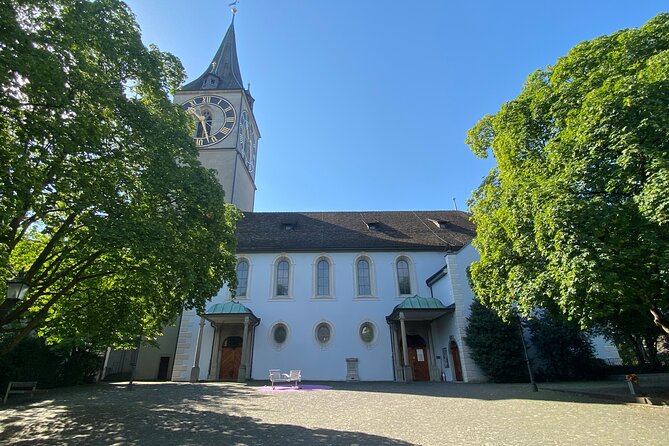
St. Peter’s Church is one of the route’s main stops. It is described as Zurich’s oldest parish church, and its enormous clock face is the feature most likely to catch your eye from outside. The clock is among the largest in Europe, giving the building a clear place in the city’s visual identity.
Allow around ten minutes here. The church interior offers a quieter change of pace, with centuries of religious use behind its walls. The tour encourages you to look beyond the clock and consider the building’s spiritual and civic role.
Thermengasse follows with traces of Zurich’s Roman baths. These remains are less dramatic than the big churches, but they add an important layer. Zurich is not only a Reformation city or a modern banking center. Roman-era remains show that urban life here reaches much farther back.
This is exactly the kind of stop that benefits from written explanation. Without context, archaeological traces can look like ordinary stonework. With a short account of what they represent, you can connect the modern street to ancient daily life.
A completely different kind of day:
- Mount Titlis and Lucerne Day Trip from Zurich
★ 4.5 · 1,960 reviews - Heidiland and Liechtenstein Tour from Zurich
★ 4.0 · 1,745 reviews - Jungfraujoch: Top of Europe Day Trip from Zurich
★ 4.5 · 1,647 reviews - Jungfraujoch Day Trip from Zurich: Swiss Alps & Bernese Oberland
★ 4.5 · 1,409 reviews
Rathaus, Cabaret Voltaire, and Lenin’s apartment
Zurich’s Town Hall, or Rathaus, brings the walk into the city’s political center. The building reflects Zurich’s civic history, and the stop helps connect local government with the larger stories of power and public decision-making that appear throughout the tour.
Cabaret Voltaire then changes the mood completely. This is recognized as the birthplace of the Dada movement, where artists, writers, and intellectuals challenged accepted ideas through strange, provocative, and experimental work. If you enjoy modern art, this will likely be one of the most memorable stops.
The route also visits the apartment where Vladimir Lenin lived during political exile. The subject matter is a sharp contrast to Cabaret Voltaire, but both places show Zurich as a meeting point for people questioning established systems.
The Lenin stop is not presented as a grand monument. Its value comes from the story of a political exile living an ordinary chapter of life in Zurich before later events changed the world. Read the passage here carefully if political history interests you.
Grossmünster: Reformation and colored light
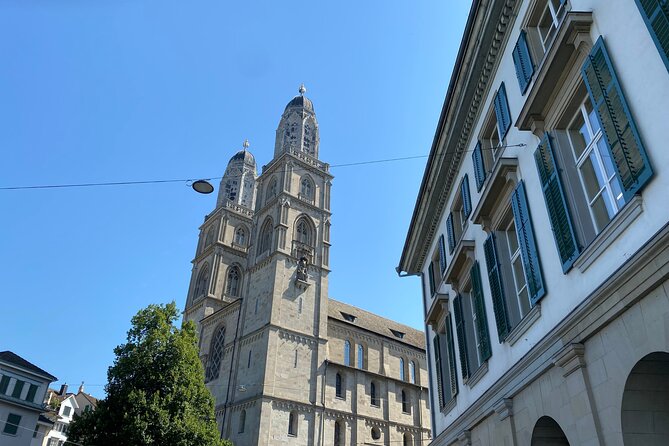
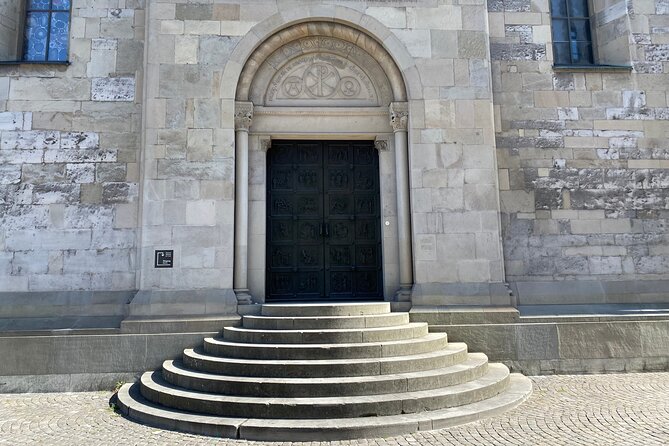
Grossmünster is the largest time commitment on the route, with about fifteen minutes suggested. Its twin towers are among Zurich’s most familiar sights, but the building matters for more than its silhouette.
The church played a central role in the Swiss Reformation, particularly through Ulrich Zwingli. The written material links the building to the religious changes that reshaped Zurich and Switzerland. This is a good point in the walk to slow down, since the city’s religious past explains much about its public buildings and traditions.
Inside, look for the stained glass windows designed by Augusto Giacometti. Their color gives the interior a very different feel from the stone exterior. You get strong architecture, religious history, and modern artistic work in one stop.
The tour lists admission as free for Grossmünster. It does not promise a special entrance arrangement, so you should treat this as a self-directed visit during opening access rather than a reserved church tour.
Wasserkirche and Zwingli’s monument
The nearby Wasserkirche sits along the Limmat and offers another chance to see stained glass. The church is smaller in the route’s treatment, with about five minutes suggested, but the windows add visual variety after Grossmünster.
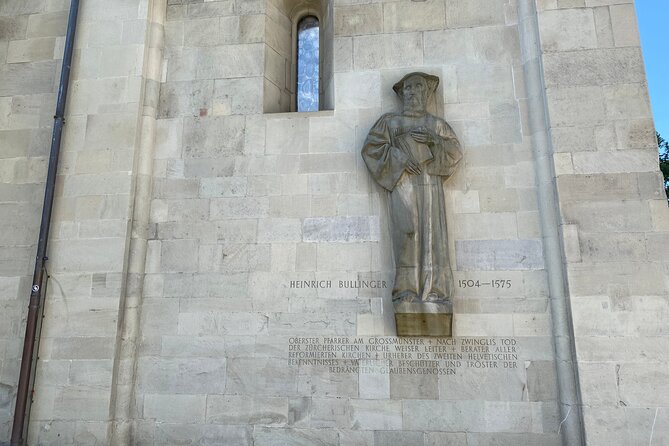
Next comes the monument to Ulrich Zwingli. The statue honors the Swiss Reformer whose ideas helped shape Protestant religious thought in Zurich. Seeing the church and monument close together gives you a clearer sense of how one person’s work became part of the city’s public identity.
The route does not ask you to accept a simple hero story. Its broader approach includes people who helped others, made dangerous choices, gained power, or paid a heavy price. That makes the Zwingli section more useful than a quick label on a statue.
Opera House, Ganymed, and Hans Waldmann
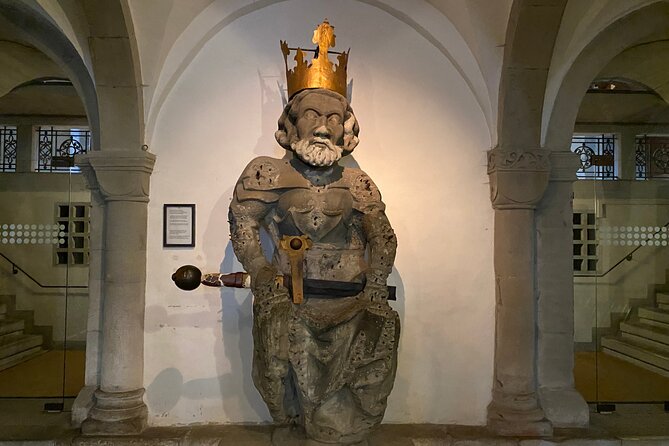
Zurich’s Opera House provides a short cultural stop. Its facade includes busts of well-known composers and writers, so take a moment to look upward rather than only at the main entrance. The building connects the city’s public space with music, literature, and performance.
The Ganymed sculpture adds a mythological note. It links sculpture with an old story and gives the route another break from churches and political monuments. You can expect only a short reading section here, but it is a reminder that Zurich’s center is also an open-air art collection.
The Hans Waldmann Statue carries one of the route’s more dramatic human stories. Waldmann rose from modest beginnings to become burgomaster and one of Zurich’s most influential figures. His career ended with a death sentence, giving the statue a sharp contrast between public success and personal tragedy.
I like this stop because it brings questions of ambition, reputation, and political fear into the open. It also prevents the walk from becoming a string of polished monuments with no difficult edges.
Fraumünster, Paradeplatz, and Augustinerkirche
Fraumünster is likely to be a highlight for anyone interested in art. The church is known for stained glass by Marc Chagall, whose windows fill the interior with color and visual storytelling.
Entry inside costs CHF 5. The tour itself does not include that admission, so decide before you begin if you want to add it. If you only view the exterior, you can still appreciate the church’s place beside the river, but the Chagall windows are the reason to pay for entry.
Paradeplatz shifts the setting from medieval churches to modern finance. It is the center of Zurich’s financial district, where commercial power and city life meet. The contrast is useful: within a short walk, you move from Reformation debates and sacred art to banking and international commerce.
Augustinerkirche offers a quieter stop. Its simple appearance gives you a moment for reflection after the grander interiors and busy financial square. The route treats it as a modest but meaningful part of Zurich’s religious past.
Bahnhofstrasse, Weinplatz, and Max Bill
The later stops bring you toward Bahnhofstrasse, one of Zurich’s best-known streets. The route includes the Max Bill Pavilion Sculpture, created in 1983, with ideas of transparency, equality, freedom, harmony, and openness attached to its design.
The stated endpoint is beside the Pavilion Sculpture at Bahnhofstrasse 47. One practical point needs attention: the written stop order places Weinplatz after the Max Bill sculpture, even though the endpoint is given at Max Bill. Use the photographs and map directions in the mobile link rather than relying only on the numbered list.
Weinplatz adds a look at the Millers’ and Bakers’ Guild Building. This is a good final historical detail because it turns attention toward ordinary working life. Guild buildings can seem decorative until you consider the trades, rules, and people connected with them.
The stop list gives Weinplatz about five minutes, and Max Bill also receives about five minutes. In practice, the exact finish may depend on the route instructions supplied to you. This is not a serious problem, but it is worth knowing before you set off.
How the $6.23 price holds up
At $6.23, the tour is inexpensive for a private city walk covering this many locations. You are paying mainly for the written research, route planning, photographs, and directions, not for a person’s time on the street.
That is excellent value if you enjoy reading and want a structured introduction to central Zurich. You can stop for a coffee, linger at Lindenhof, spend more time in Grossmünster, or shorten sections that do not interest you.
The price is less attractive if you want conversation, spontaneous questions, or local recommendations from a guide. There is no live guide, and you must provide the phone and internet connection needed to open the route.
The Fraumünster entrance is the only clearly stated extra cost. At CHF 5, it is modest, but you should include it in your budget if Chagall’s work is a priority.
Who will get the most from this experience?
I would choose this tour if you want to see many central Zurich landmarks while learning the stories behind them. It suits independent visitors, couples, families with older children, and anyone who dislikes fixed group schedules.
It is also a good fit for repeat visitors. The available written feedback came from someone who had lived in Zurich for more than five years and still found new facts in the route. That is a useful clue about the tour’s depth: it is not only for first-time sightseeing.
You may want a different format if you prefer audio, conversation, or a fast overview. Reading on a phone for several hours can feel tiring, especially if you are also trying to navigate busy streets and look inside churches.
The route is private, service animals are allowed, public transportation is nearby, and most people can participate. Confirmation arrives at booking, and cancellation is free if you cancel at least 24 hours before the local start time. Within 24 hours, the payment is not refunded.
Should you book the Zurich self-guided reading tour?
Book it if you want low-cost depth and complete control of your pace. The route covers Zurich’s biggest sights but also gives time to smaller details, from Roman baths and guild buildings to Lenin’s former apartment and the Ganymed sculpture.
Skip it if you need a live human guide or dislike reading from your phone. For everyone else, $6.23 is a small price for a well-packed introduction to Zurich, with one sensible upgrade: add the CHF 5 Fraumünster visit if you want to see Chagall’s windows from inside.
FAQ
How much does the self-guided Zurich tour cost?
The listed price is $6.23 per person.
How long does the tour take?
The estimated duration is two to three hours. Reading every section carefully may take almost three hours or longer.
Is there a live guide?
No. You explore the route independently using a link provided after booking.
What do I need to use the tour?
You need your own mobile phone with internet access.
Where does the tour start?
The starting point is Bahnhofplatz, 8001 Zürich, Switzerland.
Where does the tour end?
The stated endpoint is next to the Max Bill Pavilion Sculpture at Bahnhofstrasse 47, 8001 Zürich.
Is Fraumünster Church admission included?
No. If you enter Fraumünster, admission costs CHF 5.
Is Grossmünster admission included?
The stop information lists admission to Grossmünster as free.
Is this a group tour?
No. It is a private activity, so only your group participates.
Can I cancel for a full refund?
Yes, if you cancel at least 24 hours before the experience start time. Cancellations within 24 hours are not refunded.
Just added in Zurich
- Crash Landing on you Tour with Private Transportation★ 5.0 · 6 reviews
- Full-Day Private Zurich Sightseeing Tour and Chocolate Tasting★ 5.0 · 5 reviews
- Zurich and Suroundings (Private Tour)★ 5.0 · 7 reviews
- Day trip to Swiss Villages from Zurich – Small Group Tour by Car★ 5.0 · 8 reviews
- Zurich Scavenger Hunt and Sights Self-Guided Tour★ 5.0 · 10 reviews
- Zurich Hauptbahnhof Train Station to Zurich Hotel★ 5.0 · 1 review
- Zürich, Lindt Chocolate, Rheinfalls and Stein am Rhein★ 5.0 · 14 reviews
- Zurich Airport Stress-Free Private Transfer★ 5.0 · 6 reviews
Self-Guided Tours, compared.
Mt. Rigi Self-Guided Tour: Lake Lucerne Cruise and Mountain Spa
Read our review →
Self-Guided Chamonix with Aiguille du Midi or Mer de Glace
Read our review →
Chamonix Self-guided Sightseeing Tour from Geneva
Read our review →
The Best of Basel’s Hidden Treasures: A Self-Guided Audio Tour
Read our review →
Einstein in Zurich: Walk in Time Exploration Game and Tour
Read our review →
Browse the lists this tour appears in