
Reviewed · SELF-GUIDED TOURS
Self-Guided Audio Tour to the Dark Side of Zurich
Dark stories hide beneath Zurich’s polished streets. This self-guided walk connects witches, executioners, judges, and condemned prisoners to familiar city sights, giving you a different way to see the old town. I especially like the flexible one-to-two-hour format and the clear route directions with photos. The professional narrator’s deep voice also gives the subject the right solemn tone.
The main tradeoff is the audio content itself. Some sections offer sharp historical detail, while others can feel like a list of facts or filler. The subject is grim, too, with torture, drownings, burnings, and executions at its center, so this is not a light sightseeing stroll.
In This Review
- Key points to know before you go
- Starting at Paradeplatz with Zurich’s executioners
- Börsenstrasse and the business of punishment
- Along the Limmat, stories of torture and witch-hunts
- Fraumünster’s Chagall windows and a welcome change of pace
- Hans Waldmann and the politics of a public death
- Wasserkirche, Felix and Regula, and the Grossmünster view
- Kirchgasse and old advice for identifying witches
- Untere Zäune and the story of a wealthy accused woman
- Neumarkt, Obere Zäune, and the machinery of judgment
- Zürich’s Town Hall and the square where sentences were pronounced
- Täufergedenkplatte and executions by drowning
- Rennweg and the baker who offered the last sip
- Herkulesbrunnen and the route’s grim finish
- How the audio format works in practice
- Is $13.22 a fair price?
- Who will enjoy this Zurich audio walk?
- Should you book the Dark Side of Zurich tour?
- FAQ
- How long does the self-guided audio tour take?
- Where does the tour begin?
- Where does the tour end?
- Is a live guide included?
- What equipment do I need?
- Is the tour available in English?
- Is entry to Fraumünster included?
- Can I cancel for a full refund?
Key points to know before you go
- Fourteen stops connect dark stories to central Zurich, beginning at Paradeplatz and ending at Herkulesbrunnen.
- The route is easy to follow, with photos and directions delivered through a link after booking.
- A professional narrator provides the audio, but you need your own phone, internet connection, and headset.
- Fraumünster Church is the one possible paid sight, with an entrance fee of CHF 5 if you go inside.
- The tour costs $13.22 per person, a fair price for an independent walk with no group schedule.
- The tone is serious and sometimes disturbing, with detailed stories about witch-hunts, torture, and medieval punishment.
Starting at Paradeplatz with Zurich’s executioners

The tour begins at Paradeplatz, one of Zurich’s best-known central squares. It is a useful starting point because you are already near the old town, the Limmat, and several major churches. You do not gather with a guide or wait for a group. Instead, you open the tour link and begin when you are ready.
The first story concerns an executioner’s residence and the unusual profession attached to it. The audio explains how executioners trained and why their work occupied a strange place in medieval society. They carried out official duties, yet their trade often pushed them to the edge of respectable life.
This is one of the tour’s strongest ideas: the city’s grand squares and handsome streets were also places where power was enforced. You are not simply hearing about an execution in an abstract textbook setting. You are being pointed toward the places where people lived, worked, judged, and died.
The stop is listed as about five minutes, though you should allow extra time to walk between locations and pause when the audio directs your attention to a building or street. The tour works best when you resist the urge to rush through each recording.
More Self-Guided Tours in Zurich
- Zurich City Tour with Audio Commentary
★ 4.0 · 372 reviews - Einstein in Zurich: Walk in Time Exploration Game and Tour
★ 4.0 · 25 reviews - Self-Guided Audio City Tour in Zurich
★ 4.0 · 15 reviews
Börsenstrasse and the business of punishment
From Paradeplatz, you continue along Börsenstrasse, connected here with the medieval residence of executioners. The narration covers popular execution methods, the executioner’s pay, and how often such events took place.
That practical detail makes this section useful. Medieval punishment was not only a matter of public anger or religious belief. It involved officials, payments, procedures, and regular work. Hearing about the salary and frequency of executions gives the executioner a more concrete place in the city’s system.
This is also where the audio may feel less personal. The tour includes many short stops, and some sections rely on lists of facts rather than a single strong story. If you prefer dramatic storytelling at every point, you may find the pacing uneven.
Still, Börsenstrasse gives you an early sense of the tour’s purpose. It changes the way you read ordinary streets. A road that now serves modern Zurich once formed part of a city shaped by public punishment and strict social boundaries.
Along the Limmat, stories of torture and witch-hunts
The walk then reaches the Limmat, where the focus shifts to accused witches. The story of Elsbeth is particularly grim. She endured fifteen days of torture, a detail that makes the cruelty of the period difficult to brush aside as distant folklore.
You should prepare yourself for direct material. The tour does not treat witch-hunts as spooky entertainment alone. It describes the suffering of people accused, questioned, and punished under systems that offered little protection to the vulnerable.
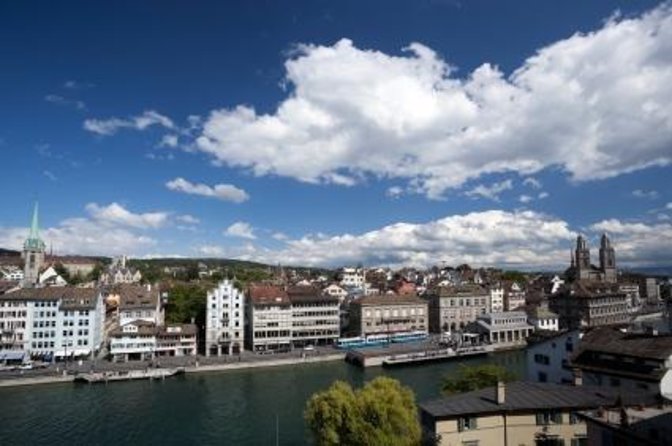
The riverside setting creates a sharp contrast. The Limmat is one of Zurich’s most attractive urban features, yet the narration links it to fear, punishment, and public control. I like this use of place because it encourages you to look beyond postcard views without pretending that every location has a dramatic marker.
The audio keeps the stop short, about five minutes, but the subject may stay with you longer. If you are sensitive to accounts of torture or human-rights abuses, you may want to skip a section or take a break.
Fraumünster’s Chagall windows and a welcome change of pace
Fraumünster Church provides the tour’s clearest visual highlight. The church is famous for Marc Chagall’s stained-glass windows, including imagery connected with the crucifixion of Jesus Christ.
The tour points you toward the church, but entry is not included. If you decide to go inside, the stated admission cost is CHF 5 per person. That extra payment is easy to assess: it is worthwhile if you want to see the windows, but you can also continue without entering.
One audio-stop review specifically advised going inside for the stained glass, and I agree with that practical suggestion based on the attraction itself. The church offers a needed visual pause after the darker material at the Limmat. It also reminds you that Zurich’s religious buildings were tied to belief, authority, and punishment in different ways.
Do not expect the church visit to become a full guided interior tour. The main experience remains the self-guided audio route, with Fraumünster serving as an important sight along the way.
A completely different kind of day:
- Mount Titlis and Lucerne Day Trip from Zurich
★ 4.5 · 1,960 reviews - Heidiland and Liechtenstein Tour from Zurich
★ 4.0 · 1,745 reviews - Jungfraujoch: Top of Europe Day Trip from Zurich
★ 4.5 · 1,647 reviews - Jungfraujoch Day Trip from Zurich: Swiss Alps & Bernese Oberland
★ 4.5 · 1,409 reviews
Hans Waldmann and the politics of a public death
At the Hans Waldmann Statue, you hear about a major figure in Zurich’s past who was executed in 1489. His story adds political drama to a route that has so far focused heavily on witchcraft and professional punishment.
The statue gives you a fixed point for thinking about how cities remember controversial figures. Waldmann’s life and death were not presented as a simple tale of good and evil. The stop asks you to consider status, public power, and the consequences of falling out of favor.
Because the tour uses existing monuments rather than special admission sites, you can stop quickly and keep moving. That makes the route easy to fit into a busy day. You are also free to pause longer if a story catches your interest.
Wasserkirche, Felix and Regula, and the Grossmünster view
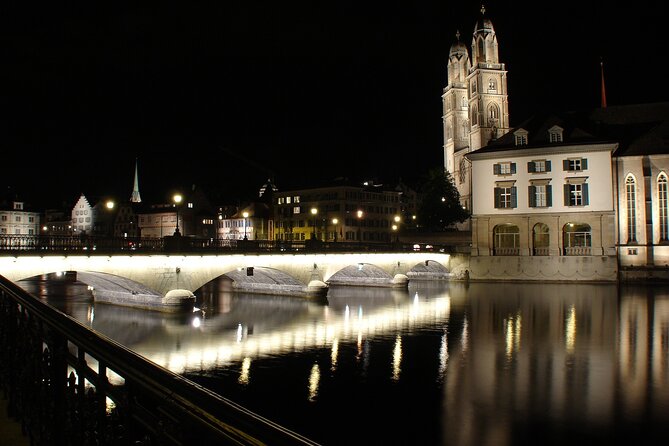
At Wasserkirche, the Water Church, the narration turns to the legend of Felix and Regula. According to the story presented in the tour, they were beheaded because of their Christian beliefs.
This stop broadens the subject beyond witch trials and civic executions. It shows how religious stories, martyrdom, and local identity became part of Zurich’s public memory. The church’s name and riverside position also make it easy to recognize as you follow the route.
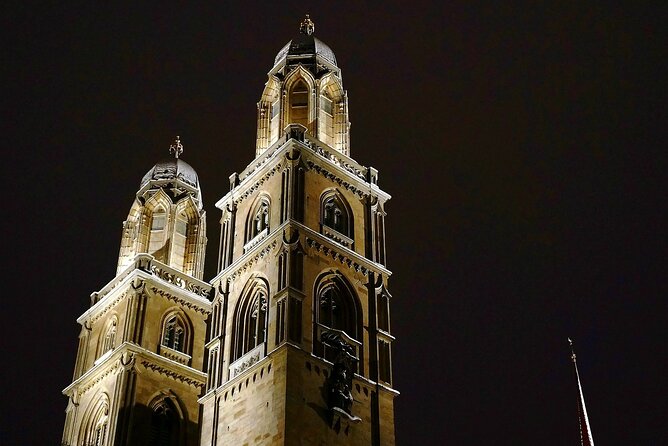
The walk passes by Grossmünster as well. You do not need to enter it for the tour to work, but its connection with the Swiss-German Reformation gives the surrounding streets another layer of religious importance.
These two churches help prevent the walk from becoming a single-note account of punishment. You are still hearing about death, but now through legends, faith, and the way Zurich presents its religious past.
Kirchgasse and old advice for identifying witches
Kirchgasse takes you into the more unsettling mechanics of witch-hunts. The audio explains old guidance about how to recognize a witch and how torture was used to force or support accusations.
This stop matters because it shows how irrational ideas could be dressed up as procedure. Once a community accepted a set of signs, suspicions could become official accusations. Torture then distorted any chance of a fair answer.
The experience is not designed to make you feel comfortable, and that is part of its value. It shows how legal systems can fail when fear and accepted superstition replace evidence. At the same time, the short format means you may want more historical explanation than the recording provides.
Kirchgasse is also a good example of the route’s practical design. You are led through regular old-town streets rather than sent from one isolated attraction to another. The audio gives you a reason to pay attention to the route itself.
Untere Zäune and the story of a wealthy accused woman

At Untere Zäune, you stop near the former residence of a wealthy woman executed for witchcraft. Her social position makes the story especially striking. Wealth did not guarantee safety when accusations became powerful enough.
The stop invites you to think about how a person’s home can become part of a public story. What is now simply an address was once tied to suspicion, legal action, and a final sentence. You may find this more affecting than general statistics because the narration connects the event to a particular person and place.
The route’s short recordings work well here. You get one focused account, then continue through the old town before the subject becomes repetitive. The downside is that the tour cannot give every individual story the space of a museum exhibit or live guide.
Neumarkt, Obere Zäune, and the machinery of judgment
Neumarkt marks the former site of a pillory. The audio explains the role of public humiliation as punishment. The pillory was not merely a physical object. It turned the crowd into part of the sentence.
At Obere Zäune, you see the house of a judge who worked during the height of the witch-hunt. His revenge story adds a more personal angle to the legal system, suggesting that private motives could sit close to public authority.
Together, these stops form one of the route’s most useful sections. You move from public shame to judicial power, then consider how the people enforcing the law were also shaped by emotion and conflict.
If you are hoping to enter historic buildings at each stop, adjust your expectations. The tour mainly takes place outside, and most locations are viewed from public streets. One criticism of the route is that it offers few places you can actually enter beyond the optional Fraumünster visit.
Zürich’s Town Hall and the square where sentences were pronounced
At Zürich’s Town Hall, the audio explains medieval prosecution and identifies the square where death sentences were pronounced. This is where the tour’s various threads come together: accusations, interrogation, judges, public punishment, and official authority.
I find this kind of stop more useful than a generic old-town commentary because it gives the square a clear civic role. You can look at the building and imagine not only government meetings, but also a community deciding who would be punished and how.
The recording stays focused on process. You learn how prosecutions worked and where sentences were announced. That procedural approach may feel dry to some people, but it gives needed context to the more emotional stories elsewhere on the route.
Täufergedenkplatte and executions by drowning
The Täufergedenkplatte memorial plate recalls executions by drowning. This is one of the route’s most sobering reminders that punishment took different forms depending on the accusation and the authority involved.
A memorial plate is easy to miss if you are simply sightseeing. The audio gives you a reason to stop and read the site as part of Zurich’s past. This is one of the better arguments for taking the tour: it directs your attention toward places that are not always obvious attractions.
The memorial also shifts the tone from historical description toward remembrance. Instead of only hearing what happened, you encounter a marker created to keep those deaths from disappearing entirely.
Rennweg and the baker who offered the last sip
At Rennweg, you hear about a baker whose duty was to provide the last sip to people being led to execution. It is a small detail, but it gives the final stages of punishment an ordinary human connection.
The baker was not the judge or executioner. His role was a simple act carried out within a harsh system. Details like this help the tour move beyond famous figures and official buildings. They show how punishment touched workers and residents throughout the city.
This is also the kind of story that suits an audio walk. You can stand on the street, hear the account, and continue without needing an exhibit or sign to explain the connection.
Herkulesbrunnen and the route’s grim finish
The final stop is Herkulesbrunnen on Bahnhofstrasse, where condemned people left the city. The recording explains where burnings and hangings took place, bringing the route to its end.
Finishing here gives the walk a clear shape. You begin near Paradeplatz with the world of executioners and end at the point where the condemned departed Zurich. The route is not simply a collection of spooky anecdotes. It follows a movement through accusation, judgment, punishment, and removal.
The ending is haunting without needing theatrical effects. A fountain and a busy city street may look entirely ordinary, which is precisely why the historical explanation works. You are left with the thought that modern Zurich grew over places where public authority once carried out severe and irreversible acts.
How the audio format works in practice
This is a private activity for your own group, not a shared walking tour. You choose the starting time and move at your own pace, which is helpful if you want to stop for coffee, enter Fraumünster, or pause when the subject becomes heavy.
After booking, you receive a link for the audio experience. You need your own mobile phone with internet access and a headset. One practical warning is worth taking seriously: the link may load slowly on a weak connection, and assistance was needed in one case before the audio worked.
The route is supported by photos and detailed directions. That makes it easier to follow than a simple audio file with no map or visual guidance. Still, test the link before setting out if possible, and make sure your phone has enough battery for a one-to-two-hour walk.
The professional narrator has a notably deep voice, a feature that suits the serious subject. The audio is offered in English only. Most people can take part, service animals are allowed, and the route is near public transportation.
Is $13.22 a fair price?
At $13.22 per person, the tour is inexpensive by Zurich standards. You are paying for a prepared route, recorded narration, location-based stories, photos, and the freedom to explore without a guide’s schedule.
The value depends on how much you like this format. If you want a polished historical walking tour with lively conversation and questions answered on the spot, this will feel limited. There is no live guide, and some audio sections contain extra facts that do not add much to the story.
If you enjoy independent sightseeing, the price works well. You can take the walk privately, stop whenever you want, and spend more time at the places that interest you. The optional CHF 5 Fraumünster admission is separate, so include that only if you plan to see the Chagall windows inside.
A 4.7 rating from 14 reviews and a 93 percent recommendation rate suggest strong overall satisfaction, but the small number of ratings means I would not treat those figures as the whole decision. The most consistent strengths are the easy route, interesting stories, flexible timing, and good value. The main cautions are technical loading problems and uneven narration.
Who will enjoy this Zurich audio walk?
I would choose this tour if you have already seen Zurich’s main sights and want a different angle on the old town. It also suits solo visitors, couples, and private groups who dislike being tied to a guide and a fixed departure time.
It is a good fit for people who enjoy:
- Local stories linked to exact streets and buildings
- Medieval justice, religion, and social history
- Short audio chapters rather than one long lecture
- Independent walks with no group pressure
- Finding less obvious memorials and former punishment sites
I would hesitate to recommend it to young children or anyone who dislikes accounts of torture, witch-hunts, drowning, burning, and hanging. The tour is also not the best first introduction to Zurich if you want broad coverage of art, food, architecture, and daily life.
Free cancellation is available if you cancel at least 24 hours before the start time. Cancellations within 24 hours are not refunded, and changes in that period are not accepted.
Should you book the Dark Side of Zurich tour?
Book it if you want an inexpensive, flexible walk that connects Zurich’s familiar center with stories of witch-hunts, executions, religious persecution, and medieval justice. The route is easy to follow, the narrator is well suited to the material, and the optional Fraumünster visit adds a welcome visual break.
Skip it if you want a cheerful city introduction, extensive interior access, or a live guide who can answer questions. For the right audience, this is a smart way to spend one to two hours. Just bring a charged phone, reliable internet, and a headset, then allow the city’s darker stories to change how you see its streets.
FAQ
How long does the self-guided audio tour take?
The tour takes approximately one to two hours, depending on your walking pace and how long you spend at each stop.
Where does the tour begin?
It begins at Paradeplatz, 8001 Zürich, Switzerland.
Where does the tour end?
The tour ends at Herkulesbrunnen on Bahnhofstrasse, 8001 Zürich, Switzerland.
Is a live guide included?
No. This is a self-guided activity using an audio link provided after booking.
What equipment do I need?
You need your own mobile phone with internet access and a headset.
Is the tour available in English?
Yes. English is the offered language.
Is entry to Fraumünster included?
No. If you choose to visit the church interior, the entrance fee is CHF 5 per person.
Can I cancel for a full refund?
Yes, if you cancel at least 24 hours before the experience start time. Cancellations within 24 hours are not refunded.
Just added in Zurich
- Full-Day Private Zurich Sightseeing Tour and Chocolate Tasting★ 5.0 · 5 reviews
- Crash Landing on you Tour with Private Transportation★ 5.0 · 6 reviews
- Zurich and Suroundings (Private Tour)★ 5.0 · 7 reviews
- Self-Guided Reading City Tour in Zurich★ 5.0 · 1 review
- Day trip to Swiss Villages from Zurich – Small Group Tour by Car★ 5.0 · 8 reviews
- Zurich Scavenger Hunt and Sights Self-Guided Tour★ 5.0 · 10 reviews
- Zurich Hauptbahnhof Train Station to Zurich Hotel★ 5.0 · 1 review
- Zürich, Lindt Chocolate, Rheinfalls and Stein am Rhein★ 5.0 · 14 reviews
Self-Guided Tours, compared.

Mt. Rigi Self-Guided Tour: Lake Lucerne Cruise and Mountain Spa
Read our review →
Self-Guided Chamonix with Aiguille du Midi or Mer de Glace
Read our review →
Chamonix Self-guided Sightseeing Tour from Geneva
Read our review →
The Best of Basel’s Hidden Treasures: A Self-Guided Audio Tour
Read our review →
Einstein in Zurich: Walk in Time Exploration Game and Tour
Read our review →
Browse the lists this tour appears in